Skip Navigation
Skip to contents

Restor Dent Endod : Restorative Dentistry & Endodontics

OPEN ACCESS

Articles

Page Path
HOME > Restor Dent Endod > Volume 48(2); 2023 > Article
Research Article Effect of an aluminum chloride hemostatic agent on the dentin shear bond strength of a universal adhesive
Sujin Kimorcid, Yoorina Choiorcid, Sujung Parkorcid
Restor Dent Endod 2023;48(2):e14.
DOI: https://doi.org/10.5395/rde.2023.48.e14
Published online: March 22, 2023

Department of Conservative Dentistry, Wonkwang University, School of Dentistry, Iksan, Korea.JFIFddDuckydqhttp://ns.adobe.com/xap/1.0/ Adobed     ! 1AQa"q 2#w8B36v7XRr$9bCt%u&Ws'(xy4T5fH  !1AQaq"2B Rbr#u67Ѳ3sTt5v8Sc$4ĂCÔ%UӅFV ?_Aנj- H>>,m*>fzp"TrKkr^r.|_&]|*vPuܶvoQ1mwVJUhu-I"=LniAƕ8"۲ k*ҿ[yu:.vUQ+)%F DHyVBk>Hy8jݹ q~9D4KRmzQ)^ʔ.J%k_tVi5NTjg!'ky|5asOȻ)R۸ߩFMԿ3L4j6dڜ#NIwUF]JqB/(FafJRzq3\G՛ ?~\ 6)6W4m[O^L0E&rRMض*C .]Unl-1 1r#Rj/&QɈ׉˩s6Rj=5Tg.y.·Pӡ:JJS:C8-2u]d&vUz;7p9 5VnL֢"y)">iי(IDDd| Yj0; LRfS:ktYK%*N2^m|&dğth":ey)uPQZW)gcC3Pv&MMWd&Ŵ۲mvTRoժM03*F3Yd6\8,\hݻ kߔi<k NTwSԪmljj[>->ptU%'LR>&EBH$MQAUx[$Z6vi&_a.KIQ{hyƒ j"JOC9eFҝfj;˚Ω<[3_m% lQ@4g=5$(J]Yc-OMq<Ǎ wSzڗ)k$7VIP붾ͯnV+卵*t]iЎD31~SA1éC2u)ʼnQn-Uoi3:grI8ؓWm*G zܕ)ZקJ}Y YlGeJ6cB2I NS3Q>k=KTBT]W6+SOXQgGR? telˊ%-Re\hѯ2TF"C/OJΩ6r[N.0{SpljjX1“jOsӥ;ҭhe}xu`Ք&.)yO̒ Fߑ.$Qw;9Iw2o+RVJMSOj[SoҌZ%;`d$blQ{Ro{Imڌ>3egf\O֝Uzx"䢸g+mv%Gʆ:|V[N'&ס-ޝ'kfE|K,G&˳98Juin/\\Qݿ̋v~Ǩ!rtWU d|E߫R4d}.qPw*Ӭv5YEcn~f5c%MTMkb-F>5JT,})QHg%{("ӔȸWMsYyWNRrkkJr0XドnͫT}r-jj,Ŕʍ\Q2Ri>v$5!]"JB2WɅ)]VԜUc8i|.jeRO6^V.¸ Q&#|ܶ-*uOG%JAtRZRr]FFG\۩w+?'zչSѧt jz>KW&ot{7P&2D;&\\>Q2JzܗAKSfeNn[jRrԕf6,q,F1tRfԗ>vֶևj-&R'Zi2=xv~Elbsvm8=ӛ"ū񕜈BȩlWau[]ٷBߨF~J!|Ipr3R̴#Yp)={7:G{+:\W}n|Q#%)7^-h"Ƒq:M*%J&$T軨I333׎g_- ucBwwjp[6i25$̏bU’ٱRv?G\~#Iͪb7<<}Ezt" q_Inw,7-d,G÷%T* Wg1"䥱kq/A.,_KhqŒxwvo u2ۥۧ.bQ}XκA$֣ +K״ZUNmڸII{.v{5z5ѮRme[moyƾd~cRݾK'j.\i&/S6f|b=5: p!6i_ 4j6=.si˧eƾtS^c.Y^RJVS-Vi3,esi08?H$GvZgg?gi䤟2adw릿:"۪lkSN>q-4kI܋ێe̊qۅgDoѨ9; #T.Q;7#~_Ufstb_'w~Xw1Xk,vcOt._}v}8"(4Z\ۘgk?J?bm_c!g{HZV]Fkk%~gEt)b秴vΰB|꽸}mp~E6ݹv;7P٤v+ri*3Ԣ|'O14_~7nP{7ZU\Vű[ +7󖱅o#:ǥŬ\|3r%TJX]V7ez¨Y]lc|O3V! R zbJ'PnGqVJ"19WVeOF埜EaEJωqCN5Z g-9[S<$sUK5b|7sn\7x qmv##FF\ w[=-43$^ooVSiXօv7iB۴yg>]Vf"r$J3""32!Zh[K%7GvNLs+4nB/B{vlsobJaҺJR:0g%&zR\ S3T[&ִor*ⷳc3ʊO[iozW٨%$gn:ܶWwFBԹjHP&z u&F2\f;ipW73 [; '_̽b;vib!oec dC-tS__$Xs]l9&z$2/N>%'[}b{h/{`{Ji׉׏ YJB/X%}.|+{(S:qz]4_Kѵo`^tY_4S#* ^zvݾMr+TrkQ g.8Ͽ^i>ӈǙvix>$o( ^qt*&t1oJVu-ql5U6jCЉmĻ*"?JT=K'O/|=Vo}l0b}}f?X[?/\JSBe,kP8ETJ==?.p5ފgbU9}ǶdNKk—_$8̸͓ۍ8Di\BԿ-1v{FF]|.^ۅ{vl12׏z7-R7wE?\nh\jN/Kձr_oBw"N QMBZqe-m:ӨSn6j4%!hQ;sv'm4kcM=!8\m[M4{SMliۇ%eֽR&N:{2A8)THLK3Zj[jPBx#BگMf:G1\`edcʮ?|w(-̮vXt,bW2;.ιNHRR#YwTM"<;mk\.foIDjmlJ;vxy7o7i\,KQŊ9d^Mmgc L*.T6tLeIuOH3SJQ3=F/ʿ<9\JM6mN6=<{xkP!F1QR[I$6ُimXu2An2yԒMU q f[IB-'䤯jYm52&JG\zд\~vdg QtHGXw&1Lw+nDEdC1w|YJmvP)HZ>i0BPβә?R:QO["]I_Jʏۍ>QKyu^bycBq4lXF~l [\*N>-J6,Gq(Zr5h]CwYӤU~ʶߑ u*SIv%ZfJ7)! FS*s_\|IŸZ)J ]ܜi4"z[+Z,MOZ))}|Ʀ(RUNIII.S'ˍO~˨rn}M)xxӕ0 eyҵ7YMAB]ӣU:/ѭ*6bcwP͵ "+qēVjŹO|GtY4V j[mLV M -m>",B$ GD1~j6O4|LxnNmqATNR3ε|DŽa[fmn-ڭ+FiK7Pcm;r5 l8r{#-]'nrFh2ruycb;pW=njRqRJ(d mnpckNnʹ+6]tz~E=ʕ l ZZ5jSi3#47.Lcfe`9؏v囜.F\-UZ:*0_<Νu9Lӵm&)_3\^ҹ3"1n1v_|uRʞͫr'iȧN_kH׺8xXrj=\МH)V\ˬ.Xʸ oVRC}ySU9/OBY먌5 ٿwޞ)rw8Ӫi5*5ZΗcGƱ !ZۄlmpjJ -l <R̵/JAպZuq\IdUS 48wXJJtcg4cI~aqߓwŷrm-v)G7yS^7H^-\mŌAq|"m9IBnF㏉9[N+mmy/!KKۉ%n +BdddfFF6FQRN-U5;Sv'm4kcM=Mn)\qιqUd9F%",6MGdT%-+~ f%+y֛^3SrF>6lc(֪vۊN;g._0Sѧ]ETWرkQKzGe9ʨsKA"yC y2\[5 rԭ7Gk5Mzw_4sM3hxЊ'oÍ5jsub )ͪ~tR2H]R͍>̋m6=%(˿(Wrr-܅y5(ܔJ޺YunW̹븹NsqK ]/QR#"ZMDfD|43Qw|._ԡSqTZBg??O Ϥ)/E_U|i}2 9Z?¹0:x'3,whǣ?C y-A~=daJј&M?D1_PS+Oi&;a @;Dž7[ zZC"bv:jjMQk$M RԸ3uA\=wI.AwC"^.{?-\NSiˏ"b}T/}q/ o.1M}R%:-ZniʒL$SgrBW*,Mw'N\ɇ{s\j]VryG'8f`}'N<*/`U숻z CwHq18J+vԕKss4R53/&XTt1bZƟo\=%nO)h$rBi-nKĪ^ ջڜlwkYm[̑+/QrZo%TQ;TLs($2C:s.%+eoNttq۰kK7O0m_t_pZ1SsSM7"mevFZ[w -FJ*T*jФQRg BSu|]g:ɵzjqwmltL.e3sRMچkSmjkmWœިm++¦'tILk*բQ D,PB\lI[9{%Gb R6öۍmX-MaʉA931cs..G4CujQտ[9 }G-xwl)IQz j Ó"rqe&=]꾧֎c)<kӳ+0JrRR3'TnXi^xMF Bު*tIL.[h"2"nKzZe'ZV/RrNYz]8죝n]Ķܩ>^Ժ]u-7^\mZjܣ9+Rmn ߑv?oꋘ?&ƪy^N4o=3-ؔ̿*`}V݁ ƒPu8%$ ݗ]wt;\y\>='OjPIp/nJU8{϶FNMsf"ίNqƹ(+ ݮF2Km |jܴZs%zf*eȫ?]4)I۵nR&FX + [jDh(#哑9q9Eծj8noǕZf\J-l&Z˫}`ӎhyrΉn\űn]9pʌӣ"׮Wt?N4_I_~54#/my1Xr*척aS#DT >q ssΛW;3oUaJSRMDgQnt:Ql,/ ܷfRqiM Ȼ>Cob;A>ڦWقM9X~/!'MW.}Vrߔꔵ!5|iB(0-zF=}okڢE$^wW~nokY߮\6՜̌{i-AF*9)\t9IV6۸5ZUF6R$ŨQIq砳YUZ]eyv >hI櫥N )&l JulwE1GDOuFN2| }馥uC1rޫV+^gdb&W[4<^e4YW,d|htͮsUM)۸8:{3d{AѢ)~ \#J=NdƮꮓ90 |1K$v*?мS ]i$J,C,SG?/_՜pMSƯM|mG1V1$~K>CSvkuj=&) -,yLjuFHK{c駗.SOua;BrSqj-ۍZ#'Jys7[g2z/.u4+XV2VQ.ޕ)$"(%)#Z7suZ%j }BǬݕe)Jvz8zJf:hIN|svO1O#IEcۍjݽ:SdὮvu^@:o^5cs>i/VqmVm]ؔܢn6'vޑ̗J4Wn@OlKbX ;n:hgJ9ŻyǑz8f܌q&Y fN0N;[69 rbׅC2/#kE l&2~èMR.*%g=Ft.%؝e8<.e=Uv{~㻏"EˑnvDѭ͜Lu3u0:U֝$[M5<:oi+V4V9 6nXvx&_ q Qqw3W:uϔ2yb/(ɳ|5zQiJ#r|Hw#.W?4aDŲ\ugWG;Cw鐢K|xg)##=O.dF˟jMUvWĻsr.z]kPc9"]R)mkfOd*uYf١RsB Aîh=k]ʳUrrZsq`d#r$/Ը3o^&lRWȍyuW̦Y4QDUMJ65ƒ[+ygk XK_±k#y:8(TJOSQhJt2.DR}"5[) r)6V6u5k:eXZmv𭤔!푊Q[qQ}ҹLE- 8qIZG|UM4j}Mܕ[Vwm{} Naqµ"ԈM zOpKѰ?IAD3Ir0'/q1itoB5{%wkOBn-ۜduqIzYK60{+DʕܞqIt";r1mG/\/ym[6JƫR \L=S=OT@Ix[TMm{>ݾտ֒ݸӉLYIx>+"JVNzx||5rI?C{oz8۹e\R-^\A2F R+N9 vlT]"ۭ d)t֞i #E2jB@׵=#/N+!ĕhx}I!cM`ąZ*ŻɄҒ߮Y.Z}='/oۙ3IpW̮hT7cTSuz9>B}΄&h!>lӵn~j˅IvU.'v'CSZw8QK3G> ,J59ٷ+HSg䧎hJdzvwv-cvxS5[̊n~ؿ%ַX?O0\6ne 6kn9.ϯ} *h 8_QhLݣ7q +=XBҲ5?[[)+F`=4 }B,sNg==u*Nj9k_GJ)+R~GSPBȒZ:(K]heL=vKPӢwq(NrG^ثϣ?#tC?.ͼ[ۅo؞y#%ǛjVyLSw%T*s92JTM%"YkQО.q)gCͲn8cgi6j1MѾ[{9h^vƘǚםidfi.^RHmg&rׇz:}݃}xT$ضk'5s-狶,\vpbPD،=Okf.c#cdz2FK5T!&)|ntD<+OŹU i-G[EE*FDfeaf2QƤM\UG_{ǹm%\yrGy:.\4wjPGUJޕUV7Do\7Vy_13w;[?c]H\$IJ,*L]3b%L{y.JRKG2sq,B6T}(#nW|km+q5] r㪍bJ@y{byz,b踊3ϻJ,'^xd،)JVw#.Vټc''ÝպWtbRؒJz۠8!o9IۄS95E9ؔ-e9JR{dmnッ<[~n${~Њ$W?&ՐY_? #a.ߑv?oꋘ?&ơ|y^N4o=3t=~7!/M3>n8W홎2M`Qx+ z qy8%]7_~540ۦ彷]Wq CѡwkďyF5Dum_}~P(5.(X,K9vᯐ?leB9;Jhm#3{CxGE-S{;@Fz˙]=O'!ɿ]' r`:7'2bЖ>Iy,/eTy/V<.H?UYY{\^#ѣr9^7?xoRȆ7EoS_&??zϾM?(~Q-K&>"~aߨ t7Emsϛ+?;fCr)fY+>z$tIkjn_>vnrֳki-˹l= t;'EyC¥|/BLwBJdgjۛ$s S1|ɍV%JI6KvəhzIlBYɒ|0"Sy0F>eo5W)O+X˻u';v)2vVq۳kۮws?UʑBǴYO漪e2MIjPAک\b1)DDؚKm6ZWΨgȕ۶yjڳ 2ضN[C[|r@9Jfo<_eI7q.|cÊV߷:i.:$ȋ)1%%)ADZCEBxJ0MJۥy(bNsKM9k43IwNt.\%N簤I'.j|ƃ2$grBEٌ\}9:v*!n7M(ɽ]7c@XxƱԨ37īf62cTTfFK]9wntQHͮvٱI/f|j=7}\_V5U^+:uljSȃY(XI.ȱmo1甅jڎIZ2>#\*:gY|4k\8ZwSqtyA!+];бޞKծË¥e)#5ap.QK^8VdU{*ѽL\=qmjnB5>{ Ӟ`v±5 ^k&O~Oshɷ,;6nOW>u6{RqS`)S%jp\ipdEBLfTWy$GIYw~䲭J.1vSY5z.V>^+Ǎvc.I[R{QsNR3ӎfhd>y?UJ*}~[e\i5U^͛E]G_FS(Iɿ]i8:4zj~շsW,ˆsy:%O}iur]iF5~3M:Ӟ#N06)4ߧgdawIotiz:1r5YDZLHBSi;NQc44la=Y kQIT*ըl:tq2(է9VO4뒳܂~2rq'nrVZŦ[t7\oլfb/mlpc.I8콚q^1iE~䰳mi[dۧw֤ICfdFeCsg:i| 6擣׋* 96lust^{%99UNRvaMܽo ammi$em4D6DD\nA%$$#}۷/ݕr99JMն[oT޲E"KTaP+HGkŴj5TM5xƱOS-k`ۛkٝWz;{kS}F;~q|~^_|euwnE'pSupUP)V]vE+t =ZRaVdG6= *.ϼnj9:UɷbېmF_tޫgHjVS'śǕًdkkѻ_]Kv?nT>)^e=Ar1'3ԔILyD?:-^in):{7.؂\.:V }#뺾.3r̸*xbFM aȵz 6SQ:ײj[ 8nn iFMw rR"5M5I旘35f^j='j:nNW.ʭocZvZKV^ɚJ.cM1ZI7E'6rg탸5oZ=[m Z`\hbMUR١Ȗĉ):Jin!_7Dй+f̷eKҷvͨBPR(V`y6tw*MRΝcB.ڭTnc;P$8nFvm4(D(R#R-L -2:FP lxZKQc6I("Km%$E, 78uXIFA$RQI$JbInG]c[ֹ:ZM+n^')JmJMJRu{e)7jQDw~%yQl}BZujSSf۩QZ+Dzhd5o%BIc'GZ?}΍:>Ɵivז-%݌J5MqGWTVʦh݇ܟ~Օ_6 n'{3~mϬj'J11OȻn߃r Qr\3y٘+WӍ'WxEs^O3 o~[|7>]]H9݇ZomT@]?5B:Z߂'`V_+/MSKX߆ޠk3?o7y:4R/7þ] iG߬aBRU&?r&/} cQߥGj2?C5Yśe7hU=?+ x龳f-܈czW^7p%-(\D4h{UK&ӡn^m]Fݢ:`δvj俜F+) y[{{ 7 tu>gvrěOj'5 iRg[ͶFjGe n~qT$ci ۚ0oԹc*jL[sVWqj\ݻ&6"WoK:cnWmrv)o>66(F>=W^bf#c zzʞtپy%mՉPël e}J.\Zk4ttt>oEM=q)hJjI=ͥ(%]脼_88ф;͛gWG;Cw~˘$4=uWdĜTثNDkiQL9U*O"4XP`02,Ge-k5$h>ܼ]3vr6!9RQPIVSnM(ۓ{>;/Qͱv{3&-[rc)ܚI$n{Sv3[j00)-D3z}MRzVQпj,T[uVs0\}Sid;r(ݝJ>æʺL&c[jPK0~d(FKÝW\m]GTcF|Iׁ)I3~#oX%vҦEݑؼ5Żv2qAZTE^..M{ʐfȏ2##.R}*KʛZz^ӞN*lPťLf\G6[WVQquV]XAi)5J!,$iJ6o$tPZc;Kjx_n3`qIelV~vLy{fn匋Ѿn%;zV.n'-ұdd2߽1bZksPe3TI9)$ԩIN9Vơ\=2885N\ p)/a柛w9g_lױo8ݷ iixJV& ғRi{N^_oAŮE6Y7I$Nk$|Q)-*4Z)^¸%4Qm [I%.c-OV+C֧R#%ѨCe3i;w$G+_dy| Fzj$DI(=OA gj%v/]8qԯNIS*֩',Q%\44ZZ%D|Ǧʴ6&vֵI$%8(ԬƾS&#Z. }6z?b/|Jl{ץv&mpx4Z$”ڝ4-H%dGKfM:sKSRWeJAn]>s6应-W9'H]'uȫYvgK^\czp|My\鏩w/ËQ.)]\QiS`8uL뚛̸=J"ܻi\å'-)54Ue]:K\퓡vK xwBqrH\*֕TnzC.mT=t-H]SČ~Nu╏NÅ3f|͡G~B+Xm[Q7U{9"~jgK Zoʰ7"qJ,ekSeNGgϳ] ^.6:s}_,%eRg<5⿨z{ZPun#jRІ.6g T.!]xa c#jN$Zpl̋H WZu8WmMRýsĮ?Mco~sx TU҆Q :KDG4n42.<3/'^?6/ܠڒ^yrrÿr2\D}}B]^E~^T cɛ7϶Y[<֞[7d}2%QPqOLEQR\CIsj1?\}%tJ0e~ *sk"*)&ۓEi#{1J8Hrt|'ܝRr8)=ƔN'RVz:cf]F7bZyZUȘ4x8,#JG̒?.W9XnO]KO]%]ƻ O5Γ/3qÓj؍/r̺rƵ 5\&m6h.xoeX[=<3%< lZ"2h\Z[&jW3ejm?k&[]ųj+{N{66leu_+lj]q* 7g*knأYv= q ەdxЬZ|%GUrQ3jLŒqET]1% qkXYūYc[7Ś]QY\jko\</Lc7+'hMSUc6qXyؙ~6#ѯv.0$BQi5YyIhɍiy=KD!n3Vm[V%W-B%swa97ajۗ m+9~]fKq|Ddaˑ0A]_v޺mM5* F-BYHJ5}q>ʉ.6hyDmpD׬'-_v5;5[8K[viJ.3dR:oYHHh9I7:۽fi+wm^ [)odPѱ52CZUJicSw\&_s0uBȍh32džzQflcd^m|7GѹE!fO5]]H9݇ZomT@]?5B:Z߂'`V_+/MSKX߆ޠk3?o7y:4R/7þ] iG߬aBRU&?r&/} cQߥGj2?C5Yśe7hU=?+ x龳f-܈czW^7p%5|Y:SJE\U-(a_cƣUǽXXKiȞNlmۊڭڄR!**ܤMeȽ$|X5(Ź\rJ~ܮ]>'HB0cp XFr_c?f?7<ukSgov¥iG>>䙗i.+t+bOjIܶ . i^:nm}s}(3>NZ$2Qg([".>i.ƾ)B̋M8+"- >eE6DݥJnJˣt׻ 5.˅nJGwZD~!i۶a,Db3ZQ3O#KO5/֍ozuK'GbRi᝘NV_ҝcvם ZoX}F6z 7e5_e:ۓj=AB+iܔERadMBq*ԯ DwI/Gy*mĥiRKg6skY/#SN4e$-yXM YL?^ĸNNӪ{$r1JJRSLO]Aqm>V/s[~i/j+m>z}eI"Qvp]{ZԼ:{vPAG2=T͡@ڐ#u"E*>C;o$~C#_d/HBq^YRٽzIKbOm\~żjFFGdiQ(*/i*#.FF]©m=BmpQQQSP&Ҫ!T&^>:y)$ˑÐFčI Bӡ-t!bM WҦŶ'UZ=}zvn~oT/\ǒ'nr8 AJIӆz<^uߖ4eFC1i+v!3qNyߕni?4JZlmYFXFۼO0B\m[ tʄU3s"Sr(NJ;SKW72L4̏BVdf^Ҹj\]ȱ۪(ӷm?J-KEmWڽ^4<8qu%9pŹW~877ܾeVгS(յe^C]yX͹! םm4FGȋ\y'Z FX7e)|Gjt߹#gb\ŧq_([R8[qU$Z (ʻezV2V!iQ,i$JE˂٩ a(GK'O{vnBvryRd-RK4=qxZJMl_CuuIz @Rt㮽޳!|68\-l[џ84-2Pu" RJ_^OL>G1~XnBŬw6J0*Uvlږ1N G1q9IUm*'oWu][&UyYZbBZRZNfEJf"+2nF~Eû7n1xv.RUM$6 lAxSQJ&n5ܞwlEói"#>4׿Q.nEq7Oko[1wg8ZQwZYiqtm&~">Bo?w͡ni2峋NCEy Ҕ+%ZJ ʩq*fpˤl,~^Mχk1+:ݕ z&Y`KLӪУDr3[*Z :(SL&ݻ۬Vqsyԭs x|iI߽zZrg.:mp%6ԜvgmpIUt;QbS.Է) ǨKSV,*lڌ|5Jt3#NP.=+OZ~/G سIgbꥹJnl_DUM\iM!֔wVZuԺ,yV.Q>f v:݇WiaŸN5Ҕ[M7SsrvǣrMW= \8ZW-jsnڕ.ZnF2qt ً[ٻޘY۷Zm"Jxr&NAfA-݌to9s359݆mZ+N1-qS$D=17 x׵+%_ ve4ir6Z$FDڗnFtOr'7'{9C˨ꤡaYoace{Refnft RR"4%ʌm:Sj3)OdInTO>X'vxV#jܮw9Fog;5.~Y5\~18YQܹvj4+~t7S ﬕs %^۵ڴDZV69R^Y+rj$ԇoJKR5wB9C>Y:l+EǎS{ʲ{T6Wi* ^^9k/y/Cs\g*qڵgn4T8mERr|Ti+iPe;;.i\EBEJ 丬i9ɧM-ԼsGDrZ>r#R>~X9y4b棇9JwV۔%m(b[Tjvl}۩~nDԺ{Zo-YuK1vx.nWuO+jN [ٮ0%"΢CdTJK-RަH"$I(*ve &҉FzB,_Vpqp9m8werv')E;o&QE׵^d9˦j\_,ڵugZȻ̧8k+jK{wmr@3ӭ2 wFkzFVqs1؛.v'I%$[iT]D5Dl2 nk7qUxԫLS+sا3/ΖeZYK<["%-g/kRs:f3;*E ت wJ%)5&+&rw*霣i|sMҴ|;R+fm䡩.!**dӶ-6s6,]zAXMWjmnz%SJߴm2UXw7MQ%<!tKys#P,W>s;3IYwx<+i_\\\U6 u7P|xbn_k&ӓVOe䦒 VUr,-㘘"-LZeOSҠթrEvq8Kf%5%&K"#%vD/.ZYYŏ+p$nZkvއuW9㓱Z G wYIFyf)?ƎUm5ԉ/'k84{KO:rQI}XRuԪ|*lu)3qZ[mSm5R3".Xcَ5c®ࢫI*۳~wRϿQWޝ(EJrri&ۥ^ʶ齲Im|[yb;mnm֩uiܘq>E+Ikx߄3r33-5𹻖09ϖ9[Tz~mr5NsWl$oPusޛ^{Z;);sڹf\3oٹZmԉ/'k84{NO:rQIBø8Bݱ3n֤DiK4u& ofSȒܩx<˘|N0Fչ]qsp"}! QWw@t4ӭ+cO5%]'*{eM߲DRO1y*q8w++e!c߶ܪlZWّM欼 CQ̼빶lX{vib/V/ ai;x6~]+z]MWB>re-:lgk}պ!#9?%܋V-c[z!W?c7YNm/jRr[HOzԻefճ0q15Zp#rkQQ0tU-AmڵP/cȕ?0cZYj;:0ZM=D6g ?'UN+ձ[K ܖB2'xq9{|۫N0ku 7xaj;n\ 2[VznMlWiKbSk))f..)Km)&bGZ=>OR܍W:j'rM'wYz&/鶧{Sʵb"vջq[I-ՌZH._x*BagC'T(Q:$ͳQcMCKy?3g'ߝqnT);qs #ؤZ}OOI:cfnc8W~qy.;^pVl]Hԓ>^H^@7-AA܃nmL(uWܻS߿ Td95Bdh4t6*dDh!EhI[iŨ\L.&Nc ܮf^;$R)\rip9I|ٺ?#R.ZDZ;/]nݻqs\QE9M&Bd ]N mN*D>tgbK>+ˏ.!23]BȔR1ɝ^j'k2ƮqBQq[$di]icV/e`޵B.FIIJqbi>Ӥ|p; 6${)RU>_e}^dzdfzi %ekRVUS?6'hׂ)5.\+qUgzE2C˷ecŏ^֔ibk shesFWJ#~> Wk~ݨ}ڶ>ơǚ)׽ZƉo~B-ڼrvoE:Ʃ3ۣK7+Y`WirS):{>ڛ}:wԨ(J_";6R%[u&ƫdZ_\'np| RJwNeTW,=rrbnkڄ[M3ܴz)3- R.?:okۼ0TU'w{6&w7j1z3ON'fGoO?)S_bQ_¿R(^ԴԴG.EtMڇ&RUiW uQjU> Kiu1d<ѥIQ'RQ1:O/lŗᏩiʂv&Jc{D5 Tt)1.n[n۶X}RjqnOʽ(~[Ns{ސ⛌uO,kgo֢dRNQȄ .'6W!׌P朼tdZjFGE"]K@'i۪N;sI[{SOzk>`rRR+!σj8&TjlvA̷Q?HyjyLHNտJMjܶT۽lG?SnKN%<‘ nq[N0Sq[Ta(&t(|HGO~gvkݻTR4&Z$#ViOY1r$6YF?e4U/Mvxų:zbU^gQQ+NW_'4jfz^c'#`rvrڡ(IJ/J ݦ6 ]-CW |_{v*_q3^DZ}Ic6Uڌ8p7{crZq5ki`)mU6|-Z5^iEz3P=:Cu7DF'k%}<C-޹ֲ̱#\,(f88%X-N(ck0VLR~} G"-8ӏ/ϰKq?(#nrVTmZ;zióM4 m |UT'C^_1X.gXM{%ʤd 4\ovN":"y-,T)fLQgۢr=/CƹǨJVr[a+!rT|%Y\ٱzsS>jͱ.oOc6f$q% ǒGo;n[];ߎjrk{~\VۓNIGn:iqxo |~t5)Rxעri{Vi&NUOl_ѮMfsޕkЄay.0P{7N((BaIP$ K"U6Gl ݙqJRu+qN$ m#*p<|{:>-Ev=86N*MM긭U*uѾ?/^o7;'u,h4݌xښRM:5.(/ \իU.{F^rmF-Jɷ.>Q"[4xT^OZ~mK}T0ݛ^SAo9u?lX(' qj%=X}"^e4wˠ|rܫ 6I\Ķ;Ӻw!'ڍWg{ i U_9Avhۣƾ+:vs/MK[ɭīe{`Zgb}r[i'GE2J7Nez579wRq+Un ]J.cJ4M:h箽Wxxm^ pc\wcN%'My $$| :$Fqɏ¾^қP9J6Wxvu}ݵP>Z'FFdg"-; [¢cmWkÎT8nG%ݣ7*\խCLRYZͤiD&J#'ehbSyXK|y*ӞpS̍R`[pTr/Eg)K+92{_ n3zwz'oŸۤ+sOj J:`T>Cf*lwd\fYOP"R E֢̔L4ɥ :;.b(B02rJ蠟9>V'9M%)IqnhP<%,r'P/vNSwr#w"ݨaqc(|{kd=^0jTMR2ULNz|.<|^PfY22##!,K~E BEJۜ&jRNsHަޛg\r,v؜.jK3)[EJ2ii{KEiHP^&]Gn8x=K}Wx/KI9-ϵwQ%spܾ[^R}S3$qvq8M[ ozKxcqmJ/ӿ{_}7&ݨ\f6ZSyQz& 7ۉ[8~UNn|nkiTB+4RI8'Nc%tn{!]Ȋo.nEmʱn𵵥J A+wy#+ikǒڂ;՛s85'KmE:Ђu""Iģ5p=БbTY-ͽڔ詻ngL2Q}$de# fs^o{DUUsfwӶ;s1T,ǤtޒQ\෼J=.tKU,7čJ5 N$y3kdSMQU~mO[03 $zAڟsF5^뜞"Կ QHmrR"ӳηer+ҔZ]hE-6Jmt'ޒ=O[sQj)6K}?e4v_KfZheޓ=BV[bY}lݒTTЬ{ȫvO_qpRApVŗ 6ju=*BR)g "O1yhb=tqJ gtm\b3RY+JQ^Ō֍\յ\>+uSi{=x ^w;uӘ#ĸzLn*$anok߷CBӷ}5Yqvdž<( "_OWit5:EZj2 B ρ1̊fi[n!HQF82q1牙nqnEpT(2RMoM4ϳOu ':֧_Xjsg jP^(ڙ{2%E͖j^}ZU[Q$'U) <܂%!s"m R'G5M0<+zM6qYm$ڕ$3ǧH]?o2N<8F1̻r_my[Rf59NjpzBnl7*{.QP 3N&^BLJPjAHCK2Q}$#~YMq8 k(MFMU)8MEqTy+Tʞ-ar5yܕOXw!e;q-Jqܶ䓊Y:LC UE{/t>r"lI9)3KJjϤA 6SEE$d߇3KG*En|P\ԭTn6I-ƍKTj<1H_zwGr19wF N8ݝ+a9ɫM6mhePi%mmD! """"""*1bRKrD"vnrM۫mmĽm]ӡiG~e"˩ lhRTMk^MX["Jݱk7_ޕ*DqĒ&flՒ}`W}~SմZ{ĕ~wm*/{{ѹ_-0ط#P]xlڱ~Tn5wi*lڪ (JxioϏbqKYR|!|KN53 OS222$jzww%i}>N)E+rۥ7c$Ofl/LNث\6H9: FY󡈾I)fB֔JI_ ֣^: 9mY{66㒢7Uj]:.-os[R&gMF3˸#໹kmjq^8W"PΦURjʄWa˧T!͋ lW48JB2ko+ /Nw QwQzQ ے%$ޓ7^YL|r7!v%Trܥ &|M8~ybrn[RV gSn{{*#2#ԽᢏӴHak" ӌcwҜw&RJ07ױ>Ļ =^ BɆ)v32.M1=#6%̠tҤnzqMwԣ~s*%-j|_m*.Yx9Sz=)qE4 3pk+,`=kNRڥ=B=nŔNAx)Q$ԩȧ4z3t#Z2lҮYn$S%y- JzGpu|LBV7ZW#;Wwipܷ%(6jFG5#{$D"uۭ~]֫SrD܃fҎӾ+Tu>-ZTQ& N|$沸ii>eRWݳu'[O̻j8JۻEѩ[]vni= ڒ,[_%kC7I3Nv$4ɎЈeٸoUu:[}Do5|zNq=Tre%ɧ6&~DȍF]ƞG5q m]/w/ \ʲr8=oʔe9U(W"|S]uZd#?Se[W"ֿh][-7Nu:T=)R}.;ml*5Dlf $fF(̏T hiIUU4Szɕ t(%_|2 ~6eM;TƗK[f&]LK^CE2[ȏBOd;Mi|cx,^6;sیGpQ\NuJIFTJ~đArh* B"$H쉩eXPRj?sl"ԥ)su]xpԴY%VESH"ЋJǰ K&5^Ukzׄ8kEgS2h&Se\ Yl]WҶp-ZUvi7QS:4byqOo+[̺腋[6-_Fo.6[7$p&^ _GZԸߍkc.qqoI[9m߸YxOZЦ1uoiSH)P9Uʄjcq= S>֙NeR><;+ڌk%_qT].srNO?s[=vH[]RZHRMtᩗVؾ:/~u)ԍdg%=edVrISb{6vSu=(ܥ)mTv/J}̇8 S3ad:^hBSf؉OɔLhI_1d8,L><_A0y3rXq"'(۱;mFNII.v5_(^q~X>y{3צ I*Vܛv/jW' T'NR'j%ꔩ:mJ3SB}΋!-H-RJBТQoedi9tjENenPpke.%4]#{:>mkEɱdYWl\\\'nRM4&U>?Ќˉk÷!𴪛]]5}UqG~ݏI"O~s6(Ļ)qO~h}uԕd}Q~G,oE!&G&/]_H-O=o{k\̭bkv.Ô܈+;arZx)m?M\3lU$mk-CFXjTv6u' g:Vn_*qk:VC A%'4JV%EY)#BғO4<e׿jQQ]yUr4=wm[K1r׵%Iũ-O}|kC;/VcݩWZ)EHdžTru]8hgĵ-;=>U_ InvTm_jBM+QiF"9*{DI/iuo(=TzϖmPQl_v4z>T*ȴ>YF;ε\t]EH4ꌇ[VrLzef 2T^V>g2~kg5~Nק;{~Z~W}&ŒBӿS2$J?~(Yœ"˲ߩ\O]: J׉ښT{mmIѩn3˧)4LdFZ/zUG>U> n 5& ϴ-KJi2o]uKljvK3$bԔҚV旧iY5.ίfi96v7!v))FJM4{jG~Jt/lUE%pTAFe4qQk\ve۽/u/Im+W')v{\-E|Pms7߮DZRr۞/mu*1ՙaB܆ -xg3#6ۥtRogʌU)׎]ZҞNnŞr}F1Nnޞ;cZ{N}ۿMiuxʉ*3qi'9KHQ$WJxXyرŔe~[v5~/jN9Q4o6rJv FrdxM*iRjMzUinHdн7ᾞS=S'7 } ̽zt7K|_g J=Lq+/Bw_\ۧx\HJUPzQ<hqF[V0x==CsU7q|^ {)Iq38$_A(VgcKu06Ƅ"%i~_ˉk QCܣB8Ku/񋇵u([w}$F|8TՠI.E !;RJ^}MɒD_q2];Ɖ{5}*n7nEInO{Mwv}&q+v [V}Ĝ@%>#dXQ$f;iep.GquixVt x6bj͵mlKقQ[T]zs/&yەnM'W}!Fp_d^Tu N{ɻ'l{խ2.sTu{W^H&;1s)Pӛ6>$mě;Łnj= fLT)>׸+qReɴ[UR\L*P/!$Ӊ3Q 'K=m~6XqW3^W+ųO_[F$rR*u"T%@O +%# ]˽!aܽz{ͷvQh쩎]hGތ5ɇ*DzJDRNLi 4:{~2FmXY-zzĽ^f=]uū{/+&c:Ma{ĝDp2m܍kHș/(--m_vݮK(V{R}.k&yƴ7i^4@3f sK3^Ř˸B=]?gt5KbZB<e;kQLpxuWC}n 5ҴepB##~q= `x]KWF {GfŲ}?G.I9pjWkU]>={7q{kO/^I3==f1ɏ%nnʫ/Zu_yXN<57ۍ'vy/"8넭M2eԷ&Y,в33%IkjMr7xf nmQkX4踼>a-GcIeތw&U=-:qnW)z¥j :WqSZvԒ#j"KrIU)%qrmRoDGQ~SYRsu*V)  ,/x)MFD6O#]z 96[Ui(JRfw'y$GeUީkdMF-ݻ98F2d[o{Rn0n-xsV6Dh|Eb2E:KCOӪv4SJCr"J!!m,hRLD| ZYFm/X~ΧfrN&4Ƒ=Z9Mh.Mܵw/BdrܥniŪ8ɧ|y%œ[M=_tj?F!z5\evM:\ ~F-sg钬OWq“iiȍ<Gi%%n2rqͻllƑ)okw7}\Uk-:&fj솘XerV9yZuʼşdFC=rmo%~ZN78X(N)_7.Εn1MpJ}62jjJdI";R5&iLԸc:jmqiQj$ujp\{;v5B񥍪Xn Ą4qOERjzN(Ga٠䌡)p*v(J7#ZۻZ8O W uONb+^Qipv9GvֽƼϯrYƖKGJQDNPhRJjᡧC"21"9ѓS1;R_O7/WGz)8fE%F2ukmvSov/iZ&/]~KmI[:^~ͤ\kMi稜\ywJt3W7 8Ʒ~ݥeFgѼw"8VVSج\뻆}ݭ/J6Q)d|)zU3>k\L=;ow֯gN3pKѫ|wmkZ$z^2R:E)f>ς нd|#׆?\ǔpV{;\$ƵE%-ͪm0S6[n< kE[}mvE4DDZ^$OZ0*$~XUv҅B@^?]so#%ojw;Y#SxxueBگy v^i-)s)zV jC{7Gt.w3v,ygg8s]aE_,*E tY5k٨h=o"m泏:\6w噓aiL׎n^c\75AGkЯ0Lf46َ`egZ˓p/k;̛]kq!ݸzpԭG"}R9Ve>ˏHUjJ-&7nrnwG*Xv\˱/vN}O)ʼn&CV͍f̵]r\PMB-6Du-#RͰtRN^)mT _}nSȕC*_xBuTkJW[`ɩ`ejvsngP ڻ.-WUtܑqԹQj)t;vN&RNũT+8%IXӃ5fK՛-d9 ]CƑm|nZ-6=Hz,*aEm W3VzRšdY~Xf׀Xx"]s;)5u*ُHB BRGS6bݶؿ 9j[1*jױga7oX CUI%0v#~\-O-Ꙛuɷ쏪&5mY٦M`LJ2qK~HZbr =N'YobI. (^ ׾{_ ?OJ`S`3BN[}5w6:ǵ/iSlt=4F*d&T4y/#. ɵim5Uֲf 眕6Y7 fơ=3dϕq뚩$qTM-%r!$@A? ޾V0c~{[{;򥧅a~ڵ»&ڄv1ek=wb MLkNAԬw-x>~/r=e73VeVN)K%Sښe"+3uXuچrn ֺVzscJ峻m}vb㶓n\YbIUBT%*,0nov=;z꣓S/nSXSpl##k9mXGrZv^Gde!ŷRԠzQyjC]`gToPov{j~KRBMY}i[߶9KL2ԉO0K#m>wB[ٍ+n[[b٦DX ݲpo] [\m5qdT()mo4Oy9Ie b][wղmM~vmi۱~t \}$яimRk(L c Cvk7r9_r1 ;zv|F@KyZ[&jEji/"6$69ml#e]9s\{ScL}Ȣؿ0q/nZ*t,CLoD߉Njǚy=Pgmu6^]l-["çUʖMlʍp-"qmU>۷uFOJ%Ǔkx 'g=睋k[3u,{³WɘݪF]ՍeFX"Oy\,cچ=w/gn Ļ]#2? vqy-gXnR.^}ݺFs{ŝG]}e|#0mjx"ƬWكm?rgU^xVB":Dt>@LRbun~ݭ,w+v⪕;\U(RYa61>#Jm˞Μ9g9XKaG='u8gf}'qy#ɉw J]We.ʲ-<+&q%s?2dњztҼn`cΤmmqMdz O[-ߩӲ&;[tmܝVnr">{x<8U+p:Ig]zjGkt,uzf}dؠoJaکqEq -(:d<պ=eKy[˗^%ZXkX[C2߱\ITTLGzANM￵i]K>UsOGDDD.ZF6* ҃V Zhz{'xp^`wo8r0h ZmJ5"jb[l=yUu7-;7IT%:jFjߖm0tzU'K)څNۧYJ)4IQ}^KWm7kSP>q;ނ#)'n7&׊r?óM{IwR\j2Qn[v pe#/tAF\ϵ225q֒om6z})6҅*oqDsMf CNIN=T S2t,_ѧ}kveMF0J\Rnnݙܹy[rUc-j{yGtkQ%s]5qB.Nw.JN1LvR Ui5J ZESQԙr):MJ+g}χ!2;q([jAud][ljVK3$ײSJI=/|&tl'*n۽f.frܥ jQO8>&Z];.|7T/C}$ڋUmP2Reҭ8hFF\L 3~e v\۫]ݝNmrnB%*]Z«hKc=BTLG :V74$=Ǘy+EX'4tn(I:Ѝ;Df8c,k1%dJ6.j6ź{N~l6&*fœI7 WAlGOu-ҢH,,(ǔe뿋쩨kM܍ZſgRvQ' 9)?n|er˭|I|-fGK.rΛp8XV1%K6mvG+tc+qE&ǸC_Nm:l=_/m5^[dߌڇ.c<%:)tQ$Ow~-aY;UJ>=F)2[nk؆?훐M=l6[4(O.]2#-H^n#->&mp5~Fӛ+|| S,xag%qkEUzUgæBhߕP(7]kFnq?֖CpruZ6*rEڊtS|*tI*E}7R<,nUU֫^I7Q*mSly%rdȓd8hE<9oHhMfNSRj[i7D[Rj݊+kდq{"$$H?p\̅S?㭻;t~R߁)^/>Qj`yt[w ԛ;²~+ߔ_ YW~|o]?x^ᯛ `ʼn;g)T@vWn]>&4lp+$D̢1l|ȨF%-}.9[}w~ ԠLM9hСablfe&QoW!s?wjLK?s7yO>(=C~_nyǜu?v3vyo oI@qV-jeES^[9WoSܝh"l2C1a͔CiJ@3:Pճw=/7ovuk+\V;lDgն<[A+rX~d;m!_s8ݖ׷;;.0llUC+?i#_crʙ1~C.\–q ul8Hܶ2m`ܻM3Tov|Bs rɵ"oLS- DКw=Tv@f'6|YlD͓Y%׵-#Ѯo%:&!3o%\J<02;K87>^vgƓ# ;ݝmz^Y6=PS39U%~ &f# }o!muH;ʲŇ˷yvP+&.7e[3'vR4Yj̗IZ`e˽3o[WU{ m[sUbۋZǾۆl6~9'V*.\S2<Sd*zY[aŶ`]C$n.v^Ʌ dng>ەZ,Mmϑ :n6nϦezWqUJ4! ۇ4R! =>>Fn|Q[{pRO17ƕ~._I''00k=b՛o}Osðc2'o\3}ݭQ^2 . R1yKȣtAݿ-uܾw!`?1Whn|gzUo[ECWwjUIן)^h#1ɭ!/Z np;o;ΗŻkXs."6E`Z1 עӐ9Kl8qd q} 2Stt;#j>;խabONŗ=fwP1j)l6J̶|gV2`y/0E˛6+ԫ1? 6}KW c\KoKͨ2ۅFw–s*TԞLיuDx .kCzWXhy۶gLu|%TnupǺl-S* PRaLnT+c+*xl.v!.U=|; !_L̎뱚U=4hm:ٯ"y)$:>%(n}X'p[ȴ ^˒4kƓmzDx \ 'NqamP7nyN݅=j7%McSڵj%STy qXymvCg{w/w=wSW5r̹u erծˊsOm=DhEҚRb#n)QOxtվQwe]I}wCa'"[ۂ-z}2UuKP$㜉ԧ:mc<Ý>RoL?wu|%ҷ&K y_!y9 ??:tq3(UU-lkS'ɸ@jdzQˬR] EVPW1DJq2n:,c|ǻ̑;y{X,ۂ.u.b˕u.tKBjQ"[S園S`ٮdNبeJ&9Ơ ~0a(Vm٘L+Jr*vڑE( x0+tp˕ n';wm-ޜMOxX>{#2%jgb2M[`K*\5@8l'e=0u+w ֘鳾{y܀:R*Ya]"Ӧ%ktynlۣ65,3gU}{GYrb;ge'TKwǘ.,rpܚV]Tr,!dp /ԺU,xՉ>s׽~W5oTh yx?xrrx?)?ilbT׬,z$Ԏ.UH٠\U1pU:]JwSrGZq8àd驐,N67QYBӢD㏙W!Q25ϸo9ms-7-%3CihO.J鯽-;MZM8ku-7k9S$8]q2E(}bۏI[DKOK}3KUB^u %Y,u.-&f#]'܆o$x`Yu,dzwM;#oKxn;\[d7}Rb+*Y䛂ZuBӱl{j0O̓}LhK;[aֶaGL{Cb#S.T[>߃F]NK"u^LUʐ_ykW?!GRj29͖qa'0[npcDvV)qz9R)PۨM^aJx W] r>];eN3vxdmĘ(5W2K1䪖weF{mE/QP6\u54x5[hۮ-Nk”i[lUgL]J}5 S:EhiUrgHl!ŒJ$pe=q^b͵Q' ?6|R\,JA ڵ"TDꈭ:ymg`B5t%M] <N_zv2_Ortٵ/i/ReӮ*7[qүqEG* m"[I:6e^p"I$jԴęh!m)]GZkcjS!{e^z}+Cѥ9;R|/ֱeiUԏCNu2Zhcٗg$ݭwvr P8*7/Lk~I'Km1+MW%Bk|oOm>-#qj*|Dbѱkn|n{v#jĮqNpMIUm(7Liz;{ҜݞڝVƚVϬ+sO!OstGvxӉ']uӎ4g_ 1^-8ۦ k!)Ύ5O;YSB#2Zzχ;<.ֵOtge~.(RC#wFZeGZٸ6FFJ4e2ˇpJT$[wgV)q6muDGJ56q\I!̗ y/I~RtJ9kJ]Iy*'FN0s.[l!fw'y(7$œ WƫgyΙdMEU JQJv̋vmrۖ.jWR_M֨djYgSj0^\y'EoECjm$ IƩK>Z28J2TiJ2N#}.s cArl嫶nB.FIJ.)۔\ZiM>/hLĸ=C1s[?YMqp|94- 鮝𦔽/k^#NT(Y LS$6˩}{;5 )B۷W$qpN)qqoot}ZDVә;7TiK|6f3h$dԄ}fqݡ>Nb򗉉+ͶO]>ߡ_VtYf79ڰիF sq~prս|QM)g%l0ocJȨHz V;Bb/kLAcfPJ,ԭ{ƍgpjNR6VSI*$!yV足jᇑ.](EܣqM\qJ2eZT).<9UB/(B0j)mtKEj#׿fDI-=rZړj|'Nڤ]k*i$5qt"ݙPM6E4ke^Z8ۏhz$Q(R Ay2zfRñnpnkbkI:=j &ΝșW?׵d{+ύM'??XqeeĽ.[o=UxFS=ӷdZwenՄ]_X=ĭVa* pKs0ބۍfJ3 gz̚i|wnxtjc¼5${(1fXQ65ȼb̶Zkn>%FQMJXӡ{TZEVNᖣimT/37cNJUPnP҂ZOE~"-Rc4^b- FEͧtf5[)S!OZIښݲ͑;tvܡ+N)AR=hCNn;wL16-:特7M$=Tҕ-.R[HٷnXk sn[ҞD-0WS9p9:-Ϸ-jѬNu{ҹfv)[Ľvwfg(ٷfe+0mYj8Q1\ݧg]Eǎvڿc!4#j5̋C2"}BRriFp7=ô\TZ:\BLfj#I22װ<;صZl j 6:l"6]۸ K'6RTѯ^ئOԓV\?$x7s#r:Oh{ց=MmuHԷd{pN /܅:UE#Yy+(SgQ(Щ)RHzw>^Ѿݻ>mK&^ '$Jۻ&w%F|xfz%˳ L~3N?Cy9 v w/{ƿ kz3x> sXv}vP"@WyC z`'톽Dw%-tt yVY\wmuPYQA0iG-2JP,6/gˢ]u.-n!Zw.N7Q]Df}Q0({a\@=i_X7gFǘ8^⻲}G MZ1)WEfO12G+=-B@z\`||w6ċj߬m}UwRox֢I &c~XGP6Qndpvܻul'V7^FJt^{b^B(L~sѣ6@߿^xqU!ڙ5|Vpvef-uӥ^3  FSDɯKD%0r}FF穛r7 +o"V8tv̖NQU!5uFd"bCr^bJ=֤fM#ʳԷP0O-9xRBm\=`r-:;~3Tl(nXtXi%2Vٛ#vwqƴ`L@"H‹qW.j,JM5B[)WܺUeZFqc'V˷1W7V̾-MHФwn8N;HPSdݷC7&2j.W\τGŎ'Vb]c.x+Rx1%C2T{myg[qU|+m:M:շ8҉yWd)ՋWS%%:iqlʹmGwݹ WnNŤѩ5(9hTٵDdGUi-)vSs2 2{OnT$Xck n:¶(lASLeȔBjμPpTb2~N2~%^k[ܗ[Jzs0ӓHBKq[}JَA-$dFQgjxxFv4r/x*Rm% `4J(&iv7SkԲmSH1YWmx 8n.k']:Z˭_W >ڃXЩ. jTq%Aā[E}amc]D:rmHRiu:uӚӢ\p(5-q%e)(۬ҖȽIf<߽pr&ݫVfY91q2ĭEQgYbTGQ&,yL+N$[q*RVۉQ=FuTܻ>f>f㋳8N6$܌n)9&»iˤsX,݅܍ȩv+sRTpO}d?Wn/Inpȸ%O]StQO|v5\}7Zwb.AIVK^:wb{[uݯcytO߶S<{8KSRׁH̏N7ۚ[xkwYy_'ZӵF+>쌛ZUĦreE9F[24De{}@:ExWs-\ǻ7K-\JNvEk%:s˙#κ].oͳ;լ7wB6nwu:$L; DkI#Wz.:Xp(˅v$Sq,wn\qIN-e<5Oe+vuYTpcojUI_ާP8 O 7&VL8z$_B-H-[uh]T{|8=qVRN-:Ij:7PUtXϷmy鉿:RIM~33ӸS2#׳GdŲ5+/Bx{(WzȨ5Y㞎#|˖+ ط.|e<o/rߔX>7s}VE.OVti׽ .5nNJO"95{#q}Ay9do]R"M6z\tnNS-D!@3N_jicWsy*5uٮRcWv/.,j}=S)j5C^> Ie =gu9ӛqjtz]۪TMoߧI!Ǧ¶m:,"[L!{qAv-o 3{"KʼnrIkfٶj2ƙ؄S`7` k6jzޞ?e5G&6uʷ2%ԒRKE*G\Npom F/V |C0.q_eenƣ<5Oh'67ɪn[SĽ{ڔjǘzs;~׌(ۂ`ܢ1ƣ` _l9Va6%UQWh~P~\F^ZHR@:ۧCJ{ôGeBh;~ۧnU J\O+n2 RҠ)ng}Kh{5+S×ܛ.1ZjG)iRȤIN 4%{oΜ/eO[Nffd ĹK?nnԼMqX'܌nZvq<ķbFnͪaQ`5 s,M_լ?-@_{w{ӺձJ}GF[%v\5[ŒGkOw/ΜM9rjË%2+rd~+󲕛C9U۳r[aJǭm|˒LAʨSCq[XMۺoubfp:t+ΤĻo ][ zt-*67kvS7D·MMCQXm;)܎n_h%]4ܙnRk!]ڵsDUF"`R, &#R_*[z*ZqFXɻ]7|۵w+'pFDەs=r./ᐚm3Hשy yD"jHCr':sA65نѮ^o1V/ f;nFr3VM)e*- s D'H݅fӧ\*޷[k<7u<-]֍Q8R h|p=WlW3s%Q %3l}@U-K6f-NϿu|ڴmWN׮[׸F*mW\%r! C78:޳vBG7ŵ.JթԚ2x)ST!řn~9 W:Wpܢ件{xf8ٳwKE ҰWxVB\qBZ 2wMb[lGSnyԚ~z9ZmያvoN2Afnݽjf>)j3 !;gOYʹK" Wftڎ+׭b*2ϻK>ۢӱeyԪXISUm[z+ugX%0lϏnvg!;t{BqPj>PyvR7Cj]O%+ݲ :qiMj6W}3vC/R=4Som]ŗ=ю, TF6U_-\6MyskwMr&Q\wjKܩyMϣUj0*}RZܷSdY3>Zjqj6TgzpA/M`/Cmл,޻feE[/+uk^Vs1W$G(JsW2ٰu*߻q*Y޵.Wi:ur5T),=0uRmho.twܖiYwrWHntvEj8qhf`Ͻpf(R&>Ki%I7$QӖm-2 ~yߗQ-앑/ x[k8nw.c㩵k}]FkbJl:{.(˩n0Hqvαp7 귎.Gupx[N`Yq'+ruU7[ү+>!xrȫoSo]OC# d^Q]\>!ƛGw^Mx"-+%vdX-:M2UR%d>%l ioSu6lsj7D P>XxHz Ukà(n^Q V>5cVtWj SEiJdznyej[lE' 3kuٌNn4JW)gB {4 j6&]' m-(ZMEz8cz>WZ6#7+[,MR-Z!4ܓtCyE|umj1ƽvƷV\;%>Q :#Le(iVz5 4ũۤUWxX ^(ҔsլB2w-V ^R+; ˂M\z+Uwr+RWY⺧~ Q*JcYSNSλUd8in=v K낫k\IRרSUaCFmϿ5̗P|u ZTԕ}>oYѲ1sfP+sQkX8Gb~6r,s>^\,mGL+7[n-E\.Fqḕcl*Jmjb5 ,m]c}NXfeVlǸJ5eˡ$4%g~N p4Y*WwW٧<8v#;qԩTut,m"#Y D\5V`\\Lȋ];LȇiS6ϝZ l>LruR\v=ǘϔDg=ԈdFZ+M{=|,[;0>RiSi4,S5}yxw&(E7&fݙ4UՕ! ~'Id)]ǽu2K-fޭ \08Vڅ쓬=Vy^^ IhyKR-B#Ըr=]mܻӾ'*Umkoy rTqT_i,/8Q^<ݤ|4ԻO(܄"'5N~#m.(Ҿ2i6Uev&I*<}҄$eNtÛzyWJubW^iBW.܅Wڮg]irO6Ve90sgv.+sV޿aޔ[p?3q*FutUo*eL\KM'EG*ZcAFfG5J 5jj=MJ3OK:k˝'NMB7m3uFҕ\-Ywg%PRqMIyZGY9|μvn߻5cWݷa^+X֥vnݘ\v7m>Fgzv"-;Ew֝}1|RjN𿊀7g#֟*GQQ|#/bo]p$>_Un9гUbn9׃ErQBU-^vDmVh'<R[fdHT]*~}3j;nvjc7s-rӳ Y8[n[1pJx kX[Jk9Mn!_Nю6x:iZ˦U |߉^Ԛ݃hYxk &U^bwKk.[jE+P(˞=9j@snCv7%c_7=xǁ<l {t'酚+1F‹l׭:ݻILruǶkL-L(K0L1&>wXB(pm;1fpnlp֓%Skidkt(U +xulo'/ڕeN r=^pZZ:Pnj8Hf"48ijY[ N[yZٻ+=  ø:3 ?^ܷ^Sr#YK[UF?CuhC b]GM')mڏsNrܗI]ljq6VB. W,UK"YX5{c >Iqā> T:n!,5l2VzCl|+I[*SrjnS6٨y+x,@>П.g+!rn9>N|W>OZT_ut Y""v7|sfި;Pclm EùN,{'fNT%U&LfH8~1v>Il}统u6P˗c(WV~H^bMU.o*oOF0N:_:6Smr_.b+|ݶYY غF,mwjv>f*>QM뭱Sd:`N{l/⎱;n-z~"Gze퇎J5S KG9!Gn;N1 ݎ h6m|S?ɂ5'WOÞ 7|7^ao @mxGmi^jϽ>01Mf0լD3-2T. VXR"ɥV Kl J O7|u?bvа;6.eߓ|[1bmRr,eRz`z 6܎-ͨku͹Fː dPhYgZUj}nvX;z=gVեTv_J }\1n7w2J?ޘγc\E 1Aޑzq;\r]]\Y&[nsNei\uURje*Qk2CSl*xJz-xٶlm+|UjUؓ`Ladqiĩ!Gd\W~fz;Tn*PdRM&T4`չSWq5k훶(N"Ӎ% V]֦wb.nUO!u*J&Oӕ2e|Z=eV쫚΅g#+/RW:طnbi*Wyo)p{:ETKؚR(RY+r웓r(IF) VmȵNB:h Q1ғ|u8E]{,'$-TR[j49l*3"I鯴zhd>Q+\BkNF=.$ZR4Nwհ(IpNi.(Gi33#33e$FXK*NdWrud[r{xnk$v2ıh+J1TQ[#JQl[tRO]LHKٮ NӍnF񨔤֞Em'MILB"ԋ%dBŋ+p̿_17jzT~4pc Vo\ƹb9Rq-'1j;8ܗ)hE%DZKS<璸Bu*%*Yw5ڻ9ۣ^z4U; Ñk\U(o~G?VUĎ:?P?_F_Kߤ~ᓾI |pr.Ok\SklRhҪz{­P .}SktZ7UQ4ڌIM8̈eaӊJZ%FFZu,KZvln廐SNFIVtuNi?CM5]+Ph,{jN JSR$IS^tSUVrORYu.9WyP6 [Kiu m!X|]Y79ӄ)\ģ)pbڳr%*&ꑶ_-H*dzk)1 V3')UAϹٶWRxe'պn۫h7AR9 EAJeGLms!%D| A 5]/Q3eb̄vnVn%za\m kZnv([emqrIҕij|""><hjJשvvǕ|Pޟs}V~2&Z?+2N&Z4w@)4iSڪ_>/JN9Hiۏuf8'It[ȲR.hZ$ȋ_Y ~U<UUO*6b)Ovzڜj\R̋.$FsQuҊj^נ䈈y<zZIuP[}Qm=C?zN(Exqu/kn S-FzKZzOסӽjJ\)F3b!r5ٝ|;6 o=-3*λ]αb\abqRi-w޵⦪~b8Kpo)Z=>)ғ"5/GTZLE-輵f7ݘ۹~+&+w/7GFI:l33fg.N~۲\2|*cnermnnM+Fq"ѪIz%j =YW8@~gc/~?N'?)«qȸs➟n=k" X“m֮VreMh2[uݖ] *FܖN)MȐ`f0 g,C9̑o;ddudJ=In13:ݒvvdMUEJLp^,6t-@͐9'{7m{-3,>hnF;ѰM)->>+Ěz!R* :`e--m7nB\u{b U>[8֪]6^ߤLʦ\DFNo$$dͶlgno8OrsQ\l̯hRo8tuNo+ CTxu!2[>ctFpeޓƻֶR"3QrQuOѳgwQr;S~)6HhZw/GgVTmUf_yt7%$];zLWF̰xy2Ʉu!MCmš_0[W6jf#a-KLi+3Q7c^qg%s<1aYIQeZf+}>;S6L0]Yu_h9߻<ƅpmiM$AVvŚ,*#t2.8Y)-Zhshü97/#Oro"u^/uFgWɺ,p:6a,^x%$Yve^3PƗMnTP&yS}OJ '덫MH^:rXԴJۋ/rI;S*,+yz1hv)Qw^ڍJ2oL׊q(\fDj:^T%vOadɂnS}ZO)N*λdaȜkG_PIEO}нa(^iQX᯦-7^)%g'SJx(.S9zVɴZ{E ))ۅi/s7 VIV-|sj0*UBTHIqRf>FP$KqN0 R̻8j\GcC}IUz\i 6F)Q{Gҧ3qSzKj-Az VЛS-zy:8*mNk|D鿓ND2u+0Yŝ7kqm·?8Ib]u>˗^_>(]vӋzv+ݩ){vZrJ2RQ몋C$z [,pp,8mڊbR]Il .f~d/ݓs㓓mͶ{mgjQwn=Oic9ܚm4Q/6ݨ[TƧ?nԶoytf{@AzT{e{[O'ZRZt~AGD?s3􌿂ՉIw'|~U\ w~di:Kޱ)U/sU%njѩ&GSP^ǝd)..!^U` 1wX[aԇSxoFV6_扐)T 2Mfd=ۖͭiZ7KK Bi9%7@<3<ճԻU,},a}FRqɛr i@ONJvK KLN M, ʖv0n-]DwlI-X6ܶ$Jʴh5O+mOI+Ra瞠\ MG7BفjYo1#͖0V`Ѱ2M?c8>-Crt*JkIGS:e#hPKx[鱼>{5m;wcն&>j-M֥^َ) 6yȜl_w{-ō̱r> U=]iw3)r*]:K]6BdCTZ|>gf}LW}[$'Y5 &c -j.z6R 67MԷFMnÌwI7w5E}o޽+K ֵy4܌ȥW"COyR[q5Ӱ͙f[v"_#q{MV6܍3"u9BK(41ӯqˇc${ߝCi6I(OmθzҜ5k^:>Jzw.>qV8{vU[ڶEm|DžBz].KHjI]x;Mɗ{m,qZXr忇2u^RO2Z}ZێS[2Jen!*NDcrBUً4<ǼMҲs1Zw57c3&ĖڻzmP*FuJG1-dN:|OU}ҵgi2t~F^^Z.VxjvŧnNNh<:]^~NN+ge^g.SԔGFe߯'[vn'(ScJ]kܗ7eJOlRrfziݮq̋S"\*U<*W]k$FջV}? 7g#֟*GQQ|#/bo]p$>_Un9;l S VvQU%OLU{οmU6bZ1MTx%!֙Q7, J=!3 ;Q,ڌ;6ͱ݅q^&ߔ·n #WbwӖX.HtG)N&d̵zpI,n cu ޖUj+VXUp[w]N o.J6Z8Ts&utxln;~HPHS/xw`G\ʡ¿rj Z^vt"[L:SD\h0sUwR,}[x^X,R2Vn< ]2YDr[SRKs8tXb̷G?Ps Tv 3be,zVz D[/I.KOEQrm'$7|[J>r S`5յwT#\w1FTz\Ԛ &"ׅhSHrD\'r]~/>p;:Piuu:"9ő=tTaS7V2rӷk7mb[^WmPp*[y.Þ6f]cizJCgRR@UVl큝.WJP1N{/\whZ ػϧӱE7|E֫Sί.x-Y&pi%v''-x6r'Ws*6=DwwUu]=C?MK [yrtܒG$!WGqJ*%SAz ED[^)/tė/g=#Omd.|^n/sl׉g DZqemqowݮRzUܜ=ڽ-o/Iۖ;qVʘgPp|mm;6zGl9.8pwWgsJ2qPbe}}UpNjٯ}7TMQKrؽtEx%v w߾8%|j;~|}pK]ơ/ w߾8%|j;~|}pK]ơ/ w&~e_H 8PL7:%ʭ5Kw&U2vwR_+rm'}C7#rWoO&HoG?M$UR7{FU]u ;# !Wk`|W>׹潇9Vn)6)*ҹ{%qV4q>W1vi#T"Qk&GwxcJBJ- Ϸ^ˁxkU}ԣ/3.;]J=<*)cS)ROK9H=,r zX @)cS)Da^ԽQ gxJI=w֣gf*TRj

Correspondence to Sujung Park, DDS, PhD. Department of Conservative Dentistry, Wonkwang University School of Dentistry and Oral Science Research Center, 460 Iksan-daero, Iksan 54536, Korea. conspsj@wku.ac.kr
• Received: September 21, 2022   • Revised: November 8, 2022   • Accepted: November 20, 2022

Copyright © 2023. The Korean Academy of Conservative Dentistry

This is an Open Access article distributed under the terms of the Creative Commons Attribution Non-Commercial License (https://creativecommons.org/licenses/by-nc/4.0/) which permits unrestricted non-commercial use, distribution, and reproduction in any medium, provided the original work is properly cited.

  • 2,491 Views
  • 62 Download
  • 2 Web of Science
  • 3 Crossref
  • 2 Scopus
prev next
  • Objectives
    This study investigated the effect of an aluminum chloride hemostatic agent on the shear bond strength (SBS) of a universal adhesive to dentin.
  • Materials and Methods
    Eighty extracted human molars were trimmed at the occlusal dentin surfaces and divided mesiodistally. According to hemostatic agent application, specimens were randomly allocated into control (C) and hemostatic agent (Traxodent; H) groups. Each group was divided into 4 subgroups according to the adhesive system (n = 20): Scotchbond Multi-Purpose (SBER), Clearfil SE Bond (CLSE), All-Bond Universal etch-and-rinse mode (ALER), and All-Bond Universal self-etch mode (ALSE). SBS was measured for half of the specimens at 24 hours, and the other half were thermocycled in water baths (group T). Fracture surfaces were examined to determine the failure mode. The SBS was measured, and data were analyzed using 1-way analysis of variance, the Student’s t-test, and the Tukey honestly significant difference test (p = 0.05).
  • Results
    No significant differences in SBS were found between groups C and H for any adhesive system at 24 hours. After thermocycling, a statistically significant difference was observed between CT+ALSE and HT+ALSE (p < 0.05). When All-Bond Universal was applied to hemostatic agent-contaminated dentin, the SBS of H+ALSE was significantly lower than that of H+ALER (p < 0.05). The SBER subgroups showed no significant differences in SBS regardless of treatment and thermocycling.
  • Conclusions
    When exposed dentin was contaminated by an aluminum chloride hemostatic agent before dentin adhesive treatment, application of All-Bond Universal in etch-and-rinse mode was superior to self-etch mode.
Blood and gingival crevicular fluid must be controlled during restorative procedures, as contamination with blood and moisture adversely impacts hybrid layer formation, as well as the resulting bond strength between restorative materials and the tooth structure [1,2]. Although rubber dam application can provide good control of the restoration area in certain clinical scenarios, this may not always be feasible, especially when dealing with class V cavities or subgingival margins [3].
Another method of controlling blood and moisture is the use of topical hemostatic agents that act either as vasoconstrictors (such as epinephrine) or blood coagulation factors (such as aluminum potassium sulfate, ferric sulfate, and iron solutions) [4]. Aluminum chloride at a concentration of 5% to 25% is commonly used as an astringent in solution or gel form [4]. It acts by constricting damaged vessels, enabling the clinician to establish a dry field for bonding procedures. Several studies evaluating the effects of aluminum chloride-containing hemostatic agents on bond strength have indicated that contamination with hemostatic agents can significantly decrease bond strength [5,6]. One reason for this decrease is the acidic nature of these substances (pH = 0.7 to 3), which can remove the smear layer and alter the dentin surface morphology [7]. Contaminants such as residual aluminum can also obstruct the dentinal tubules and subsequently inhibit the inward flow of resin monomers [8].
Universal or multi-mode adhesives have recently been introduced. These can be used in either a 2-step etch-and-rinse mode or a 1-step self-etch mode. This versatility gives the practitioner a choice of bonding techniques for use in clinical situations.
Few studies have been conducted to evaluate the bonding strengths of new universal adhesives to hemostatic agent-contaminated dentin. Thus, the purpose of this study was to determine the effect of aluminum chloride-containing hemostatic on the shear bond strength (SBS) of different adhesives, including universal adhesives to dentin. The null hypotheses tested were that 1) an aluminum chloride-containing hemostatic agent would have no effect on the dentin SBS values of various adhesive systems, 2) the application mode of All-Bond Universal adhesive would have no effect on the dentin SBS to hemostatic agent-contaminated dentin, and 3) the SBS measurements of various adhesive systems to hemostatic agent-contaminated dentin would not be affected by thermocycling.
Sample preparation
This study was approved by the Institutional Review Board of Wonkwang Dental Hospital, Wonkwang University, Iksan, Korea (WKIRB-201512-BR-006). In this study, 80 extracted noncarious human molars were used. The teeth were stored in a 0.4% chloramine-T solution and used within 3 months of extraction. The teeth were prepared in sections perpendicular to the long axis of the crown to a level 2 mm below the dentinoenamel junction using a low-speed diamond saw (IsoMet; Buehler, Lake Bluff, IL, USA). The prepared teeth were embedded in cylindrical molds using a self-curing acrylic resin (Ortho-Jet; Lang Dental Manufacturing Co. Inc., Wheeling, IL, USA), allowing the occlusal surfaces of the dentin to be exposed. The exposed surfaces were ground with 600-grit abrasive paper (CC261; DEERFOS, Seoul, Korea) for 30 seconds to create the smear layer. The occlusal surfaces were subsequently divided into 2 parts mesiodistally, and the bonding procedures were performed on each part.
The prepared specimens were randomly divided into 2 main groups according to the application of the hemostatic Traxodent Hemodent paste displacement system (Premier Dental Products Co., Plymouth Meeting, PA, USA) prior to the application of dentin adhesive.
Control group (C): No contamination.
Hemostatic agent contamination (H): Traxodent hemostatic agent paste was applied to the dentin surfaces and pressed lightly with a cotton pellet to ensure close contact with those surfaces according to the manufacturer’s instructions. After 2 minutes, the hemostatic agent was rinsed thoroughly for 30 seconds and air-dried for 10 seconds.
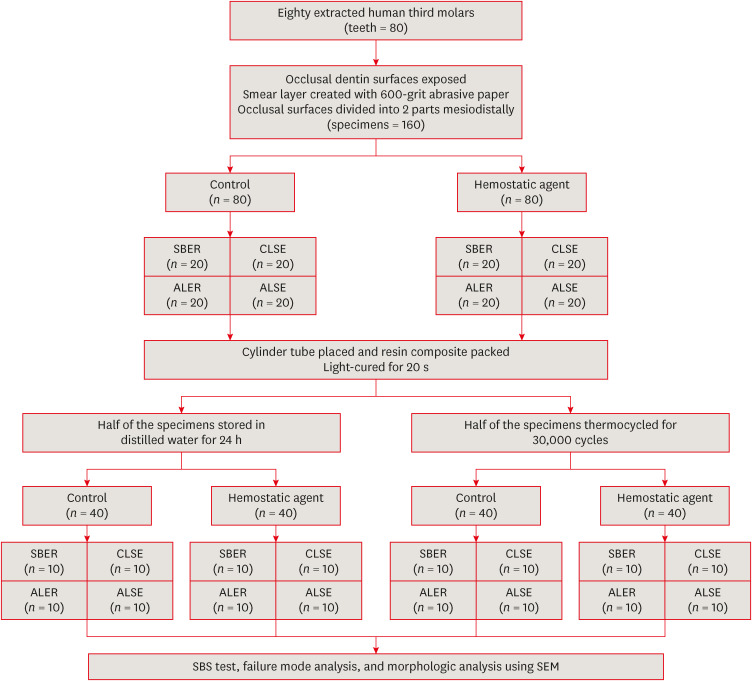
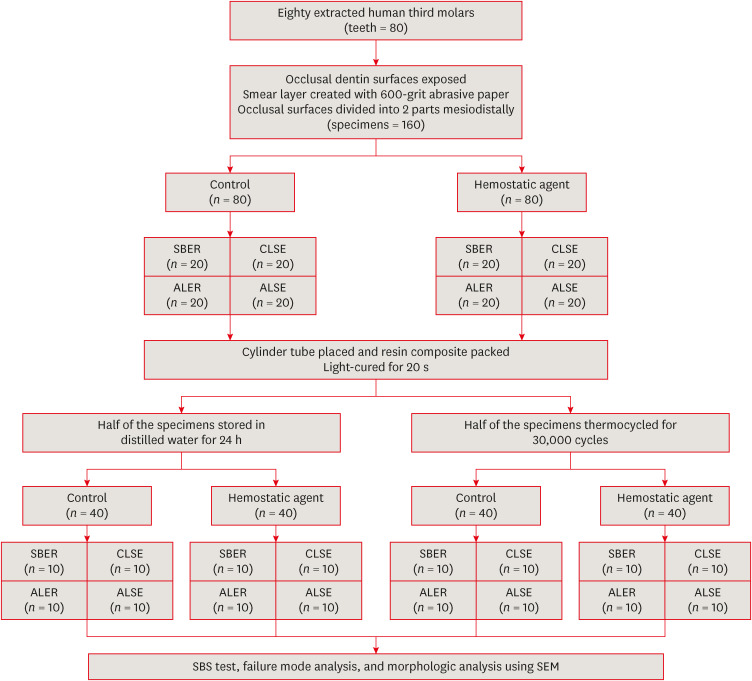
Each group was divided into 4 subgroups based on the adhesive system used, as shown in Figure 1. The materials used in this study are presented in Table 1, and the tooth treatment procedure by subgroup, detailed below, is briefly described in Table 2.
Figure 1

Schematic representation of the experimental procedure and testing groups.

SBER, Scotchbond Multi-Purpose; CLSE, Clearfil SE Bond; ALER, All-Bond Universal in etch-and-rinse mode; ALSE, All-Bond Universal in self-etch mode; SBS, shear bond strength; SEM, scanning electron microscopy.
rde-48-e14-g001.jpg
Table 1

Composition and manufacturers of materials used in this study

Materials Manufacturer Lot number Composition
Traxodent Hemodent Paste Retraction System Premier Dental Products Co., Plymouth Meeting, PA, USA 71156 15% aluminum chloride, montmorillonite, fumed silica, potassium nitrate
Ultra-Etch Ultradent, South Jordan, UT, USA ET523137 35% phosphoric acid, cobalt aluminate blue spinel, cobalt zinc aluminate blue spinel
Scotchbond Multi-Purpose 3M ESPE, St. Paul, MN, USA Primer: N591853 Primer: HEMA, polyalkenoic acid, copolymer (Vitrebond)
Bond: N557534 Adhesive: Bis-GMA, HEMA, dimethacrylates, initiators
Clearfil SE Bond Kuraray, Osaka, Japan Primer: 01247A Primer: 10-MDP, HEMA, hydrophilic dimethacrylate, water
Bond: 01877B Bond: 10-MDP, Bis-GMA, HEMA silanated colloidal silica
All-Bond Universal Bisco, Schaumburg, IL, USA 1400004366 10-MDP phosphate monomer, HEMA, bis-GMA, ethanol, water, initiators
Filtek Z350XT (shade: A1) 3M ESPE, St. Paul, MN, USA 7018A1E Bis-GMA, UDMA, TEGDMA, Bis-EMA, PEGDMA, silica filler, zirconia filler, zirconia/silica (aggregated)
HEMA, hydroxyethylmethacrylate; bis-GMA, bisphenol A glycidyl methacrylate; MDP, methacryloyloxydecyl dihydrogen phosphate; UDMA, urethane dimethacrylate; TEGDMA, triethylene glycol dimethacrylate; bis-EMA, ethoxylated bisphenol A dimethacrylate; PEGDMA, poly(ethylene glycol) dimethacrylate.
Table 2

Dentin surface treatment and application procedures

Group Application procedure
SBER 1. Dentin surfaces were acid-etched with Ultra Etch (Ultradent, South Jordan, UT, USA), 35% phosphoric acid for 15 seconds, rinsed with water for 15 seconds, and subsequently blotted dry.
2. Scotchbond Multipurpose (3M ESPE, St. Paul, MN, USA) primer was applied to the dentin and gently air-dried for 5 seconds.
3. Adhesive was applied, gently air-dried, and light-cured for 10 seconds.
CLSE 1. Clearfil SE Bond (Kuraray, Osaka, Japan) primer was applied to dentin, left for 20 seconds, and gently air-dried.
2. Adhesive was applied for 15 seconds and then cured for 10 seconds.
ALER 1. Dentin surfaces were etched with Ultra Etch for 15 seconds, rinsed with water for 15 seconds, and blotted dry.
2. All-Bond Universal (Bisco, Schaumburg, IL, USA) was applied to the dentin in 2 separated coats, the dentin surfaces were scrubbed for 10–15 seconds per coat, and excess solvent was evaporated by thoroughly air-drying for at least 10 seconds.
3. The adhesive was light-cured for 10 seconds.
ALSE 1. All-Bond Universal was applied identically as in group ALER without etching.
All adhesives were used in accordance with the manufacturer’s instructions.
SBER, Scotchbond Multi-Purpose; CLSE, Clearfil SE Bond; ALER, All-Bond Universal in etch-and-rinse mode; ALSE, All-Bond Universal in self-etch mode; ALER, All-Bond Universal in etch-and-rinse mode.
Scotchbond Multi-Purpose (SBER): Dentin surfaces were acid-etched with 35% phosphoric acid (Ultra-Etch; Ultradent, South Jordan, UT, USA) for 15 seconds, rinsed with water for 15 seconds, and subsequently blotted dry. Scotchbond Multi-Purpose (3M ESPE, St. Paul, MN, USA) primer was applied to the dentin and gently air-dried for 5 seconds. Adhesive was then applied, gently air-dried, and light-cured for 10 seconds.
Clearfil SE Bond (CLSE): Clearfil SE Bond (Kuraray, Osaka, Japan) primer was applied to the dentin, left for 20 seconds, and gently air-dried. Adhesive was applied for 15 seconds and then cured for 10 seconds.
All-Bond Universal etch-and-rinse mode (ALER): Dentin surfaces were etched with Ultra-Etch for 15 seconds, rinsed with water for 15 seconds, and blotted dry. All-Bond Universal adhesive (Bisco, Schaumburg, IL, USA) was applied to the dentin in 2 separate coats, the dentin surfaces were scrubbed for 10 to 15 seconds per coat, and excess solvent was evaporated via thorough air-drying for at least 10 seconds. The adhesive was then light-cured for 10 seconds.
All-Bond Universal self-etch mode (ALSE): All-Bond Universal was applied identically as in the ALER group, but without etching.
Adhesives were light-cured with a light-emitting diode (LED) light-curing unit (Elipar S10; 3M ESPE). The light intensity was 1,000 ± 40 mW/cm2. The cylinders of the resin composite (Filtek Z350 XT; 3M ESPE) in a cylindrical Teflon mold (2.38 mm in diameter × 3 mm in height) were placed over the bonding surface of each tooth according to ISO 29022:2013. Specimens were stored in distilled water for 24 hours at room temperature. Half of the specimens were thermocycled in a water bath (Rika-Kogyo, Hachioji, Japan) for 30,000 cycles between 5°C and 55°C with a 30-second dwell time and a 30-second transfer time to simulate the conditions of the oral cavity (groups CT and HT).
Shear bond strength test and statistical analysis
The SBS was measured using a shear bond tester (T-63010K; Bisco) with a half-round notch at a crosshead speed of 1 mm/min until failure. The SBS values were recorded in MPa. The SBS was calculated by dividing the maximum load at failure by the cross-sectional surface area. The SBS test data were normally distributed and were statistically analyzed using 1-way analysis of variance to compare the effects by bonding system. Additionally, the data were analyzed using the Student’s t-test to determine the effects of hemostatic agent and thermocycling. The Tukey post hoc test was used. The sample size for the in vitro study was determined using G*Power 3.1 software (University of Düsseldorf, Düsseldorf, Germany). A power analysis using the F test was applied (effect size = 0.5, power = 0.95) to identify the required sample sizes. The Shapiro–Wilk test was used to assess the normality of distribution prior to the statistical analysis. Statistical significance was considered to be indicated by a p value of less than 0.05. All statistical analyses were performed using SPSS for Windows version 18.0 (SPSS Inc., Chicago, IL, USA).
The results of the SBS test are shown in Table 3. At 24 hours, no statistically significant differences in SBS were present between the C and H groups for all adhesive systems tested. After thermocycling, a statistically significant difference was noted between the CT+ALSE and HT+ALSE groups (p < 0.05). No statistically significant differences were found within group C; however, within group H, the SBS of the H+ALSE specimens was significantly lower than that of the H+ALER group (p < 0.05). Within the CT subgroups, no statistically significant differences were present among adhesives, and within the HT subgroups, no significant differences in SBS were found between HT+SBER and HT+ALER. Notably, the SBS value of HT+ALSE was the lowest among the adhesive systems (p < 0.05). When comparing the specimens before and after thermocycling, the SBS of HT+ALSE was significantly lower than that of H+ALSE (p < 0.05). The subgroups of SBER exhibited no significant differences in SBS regardless of treatment and thermocycling. The SBS of HT+CLSE was significantly lower than that of H+CLSE (p < 0.05).
Table 3

Mean shear bond strength values ± standard deviation (MPa) (n = 10)

Group Time
24 hours Thermocycling (T)
C H CT HT
SBER 10.58 ± 4.08Aa 9.42 ± 3.68Aba 9.56 ± 2.39Αα 8.16 ± 3.42ABα
CLSE 10.38 ± 2.17Aa 8.63 ± 3.81Aba 9.19 ± 3.50 6.49 ± 2.91
ALER 10.64 ± 3.17Aa 11.69 ± 1.90Aa 9.83 ± 2.20 9.92 ± 2.63
ALSE 9.48 ± 2.86Aa 7.31 ± 1.56Ba* 7.43 ± 1.57 2.34 ± 1.63Cβ*
SBER, Scotchbond Multi-Purpose; CLSE, Clearfil SE Bond; ALER, All-Bond Universal in etch-and-rinse mode; ALSE, All-Bond Universal in self-etch mode; C, control; H, hemostatic agent application; T, thermocycling.
Groups with different uppercase (columns: comparison among adhesive systems) and lowercase (rows: comparison between C and H groups) letters differ significantly.
*The asterisk indicates a statistically significant difference between before and after thermocycling.
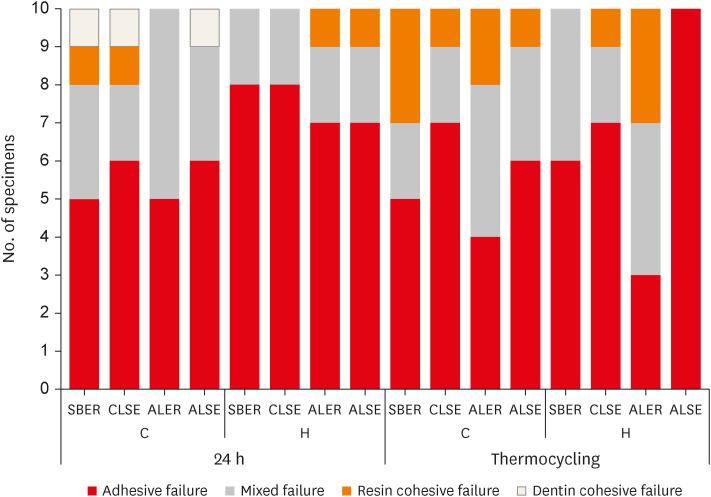
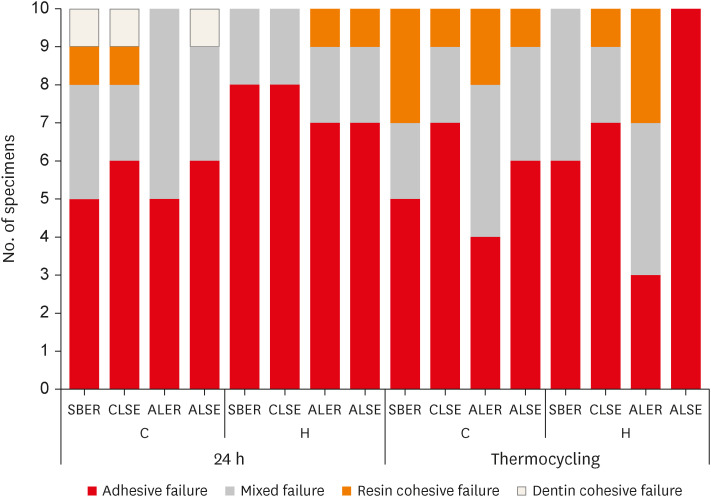
The failure modes are shown in Figure 2. A higher percentage of adhesive failure was observed after hemostatic agent application in all groups except HT+ALER. All HT+ALSE specimens displayed adhesive failure.
Figure 2

Failure modes after the shear bond strength test. The most prominent failure mode was adhesive failure except for HT+ALER. All HT+ALSE specimens showed adhesive failure.

C, control; H, hemostatic agent application; T, thermocycling; SBER, Scotchbond Multi-Purpose; CLSE, Clearfil SE Bond; ALER, All-Bond Universal in etch-and-rinse mode; ALSE, All-Bond Universal in self-etch mode.
rde-48-e14-g002.jpg
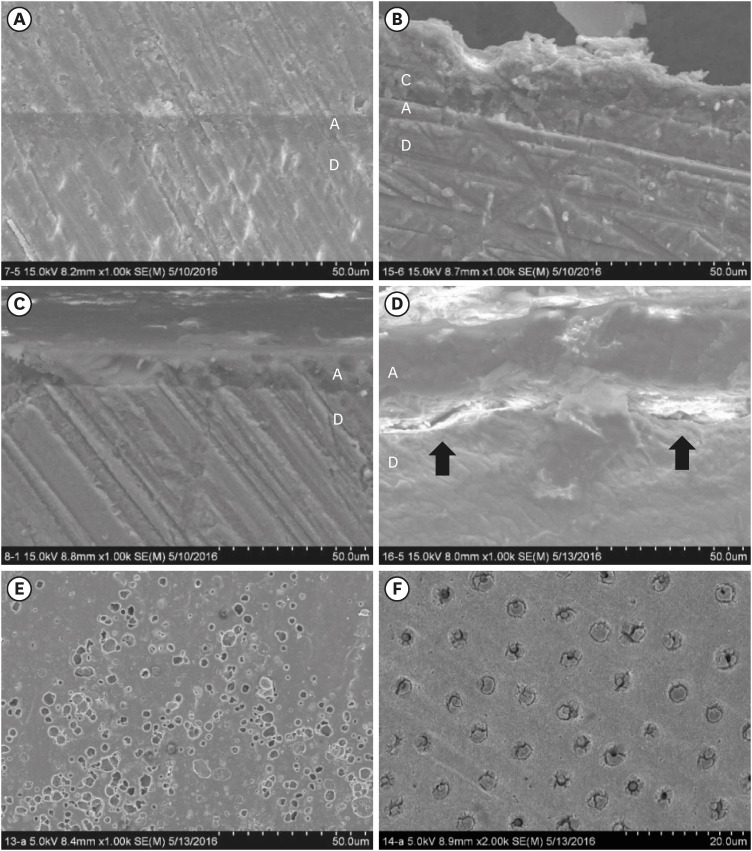
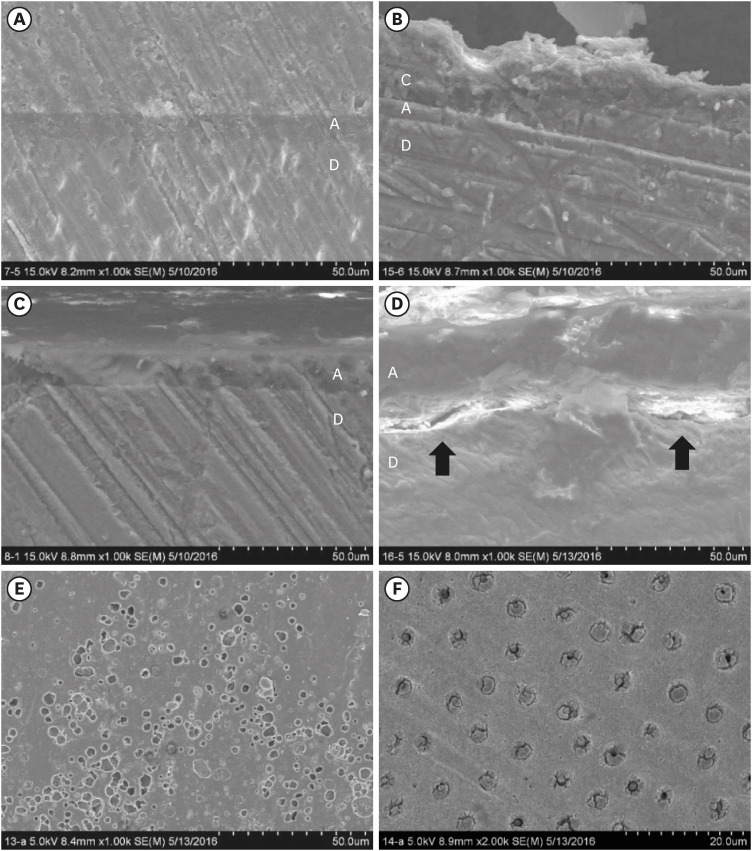
For the specimens for which All-Bond Universal adhesive was used, the morphologic characteristics of the dentin/adhesive interfaces are shown in scanning electron microscopy (SEM) (S-4800; Hitachi, Tokyo, Japan) micrographs (Figure 3). No differences were seen in the dentin/adhesive interfaces of the H+ALER and HT+ALER groups (Figure 3A and B). However, gaps between the dentin and the ALSE adhesive layer were observed after thermocycling (Figure 3D). In the SEM image of HT+ALSE, numerous pores were noted above the adhesive layers (Figure 3E).
Figure 3

Scanning electron microscopy images of specimens with All-Bond Universal after Traxodent application (A-E; ×1,000, F; ×2,000). (A) Image of H+ALER specimen. (B) Image of HT+ALER specimen. (C) Image of H+ALSE specimen. (D) Image of HT+ALSE specimen. Gaps were observed between the dentin and adhesive layer (black arrow). (E) Adhesive layers of HT+ALSE specimen. Multiple pores were noted above the adhesive layers of the HT+ALSE tooth. (F) Dentin surfaces of HT+ALSE specimen in the area where adhesive failure occurred. Obstructed dentinal tubules were shown on the dentin surface of the HT+ALSE tooth.

H, hemostatic agent application; T, thermocycling; ALER, All-Bond Universal in etch-and-rinse mode; ALSE, All-Bond Universal in self-etch mode.
rde-48-e14-g003.jpg
Hemostatic agents are acidic (pH = 0.7 to 3.0) [9], with hydrophilic characteristics that can contaminate every stage of the bonding procedure and subsequently cause morphologic changes in dentin surfaces [7,10]. In addition, contaminants, such as residual particles of the hemostatic agents, can obstruct the flow of resin monomers into the dentinal tubules. Thus, hemostatic agents can negatively affect bond strength [11].
In the present study, the first and second null hypotheses were rejected. At 24 hours, hemostatic agents reduced the SBS of the H+ALSE specimens significantly more than the H+ALER specimens. This result aligned with the findings of a previous study by Kuphasuk et al. [6], who reported a decrease in the SBS of a self-etching adhesive after the application of an aluminum chloride hemostatic agent.
The hemostatic agent, the Traxodent Hemodent Paste Retraction System (Premier Dental Products Co.), was selected for the present study based on its specific formula. The Traxodent system consists of an aluminum chloride topical paste and cotton caps used to efficiently compress the paste material for retraction of the gingival sulcus. Traxodent paste is a clay-based paste that contains 15% aluminum chloride with 85% fillers in addition to water and various modifiers [12]. The fillers are composed of montmorillonite and fumed silica. Montmorillonite, from the smectite group of clay minerals, can absorb a large amount of water due to its layered structure [13]. Upon exposure to the blood, it absorbs water and thus concentrates the remaining clotting factors [14]. When montmorillonite is exposed to blood, it swells into a clay paste with high plasticity and strong adhesive properties [15].
In the current study, Traxodent paste was lightly pressed with cotton pellets to simulate the use of a cotton cap with paste and was applied for 2 minutes in accordance with the manufacturer’s recommendations. As the manufacturer did not stipulate rinsing time, the paste was rinsed off with a water spray for 30 seconds as performed in previous studies [6,11,16].
Previous studies commonly involved a solution or gel containing 25% aluminum chloride; however, in the present study, a paste with 15% aluminum chloride was used [5,6,11,16,17,18]. The clinical hemostatic performance of 15% aluminum chloride paste is known to resemble that of the 25% solution; however, few studies have been published evaluating the dentin bonding strength to 15% aluminum chloride paste-contaminated dentin [19]. The results of the present study seem to corroborate the results obtained using the 25% aluminum chloride solution. This finding suggests that residual aluminum contaminants are similar between the 15% aluminum chloride paste and the 25% aluminum chloride solution/gel, as evidenced by the paste’s strong adhesive properties. Furthermore, rinsing for 30 seconds may be insufficient to remove the paste preparation, unlike the solution or gel materials.
In a study by Ayo-Yusuf et al. [20], hemostatic agents appeared to remove the smear layer and formed a granular precipitate on the dentin surface. The researchers concluded that the exposure of the dentin surface to hemostatic agents altered its morphology and reduced its susceptibility to etching [20]. As previously reported, an aluminum chloride-contaminated tooth can inhibit hydroxyapatite demineralization via the exchange of calcium for aluminum in hydroxyapatite, resulting in the formation of Al(OH)2H2PO4, which is insoluble and has an increased resistance to acid [21]. Because of the weak acidity of the self-etch primers relative to phosphoric acid, they would reasonably be expected not to sufficiently remove aluminum contaminants, and their penetration to deeper areas of the dentin tubules would be impossible. In etch-and-rinse mode, phosphoric acid can demineralize the dentin and remove the remaining contaminants from the dentin surface. Phosphoric acid in etch-and-rinse mode may therefore function as a cleaning agent for aluminum chloride-contaminated dentin [22].
The third null hypothesis, that the SBS values of adhesive systems to hemostatic agent-contaminated dentin are unaffected by thermocycling, was rejected.
Thermocycling is a common aging method used to investigate bond stability. The use of 10,000 cycles corresponds to approximately 1 year of clinical functioning [23]; thus, the 30,000 cycles used in this study simulate approximately 3 years of clinical function.
After thermocycling, the HT+SBER, HT+ALER and HT+CLSE groups exhibited bond durability; however, a significant decrease in the SBS of HT+ALSE was observed. Comparing adhesive systems, the SBS values associated with etch-and-rinse modes (HT+SBER and HT+ALER) were higher than those of self-etch modes (HT+CLSE and HT+ALSE). The SBS of HT+ALSE was the lowest among the adhesive systems, constituting a significant finding.
Depending on the pH, Clearfil SE Bond can be classified as a mild self-etch adhesive system (as it is at a pH of 2.0), whereas All-Bond Universal is classified as ultra-mild (at a pH of 3.1). Etching aggressiveness is related to acidity, and milder self-etch adhesives therefore show a lower capacity to penetrate thick smear layers than do stronger ones. In conclusion, Clearfil SE Bond showed superior performance to All-Bond Universal in self-etch mode after hemostatic agent application due to the relatively hydrophobic properties and lower pH values of Clearfil SE Bond.
Clearfil SE Bond is a mild 2-step self-etching adhesive system, while All-Bond Universal is classified as an ultra-mild multi-mode adhesive. These 2 materials contain a 10-methacryloyloxydecyl dihydrogen phosphate (MDP) monomer, and 10-MDP is known to chemically interact with hydroxyapatite to form a hydrolytically stable bond with calcium [24]. However, the present study demonstrated reduced bond durability to hemostatic-contaminated dentin for the self-etch mode adhesives, especially ALSE, perhaps because they contain hydroxyethyl methacrylate (HEMA) as well as 10-MDP. Tay et al. [25] demonstrated that when water was incompletely evaporated from dentin, porous hydrogels were formed through copolymerization with HEMA and acidic monomers. In addition, the presence of water may cause insufficient polymerization in the resin matrix [25]. These insufficiently polymerized regions may allow water permeation, affecting the bonding durability. HEMA may also compete with 10-MDP by binding to the calcium on the surface of apatite crystallites, leading to reduced nano-layering of 10-MDP-calcium salts in the resin–dentin interface [26].
In the SEM images, no differences were observed in the dentin/adhesive interfaces of the etch-and-rinse mode application group before and after thermocycling (H+ALER vs. HT+ALER). Gaps between hemostatic-contaminated dentin and adhesive were observed in the self-etch group after thermocycling (HT+ALSE). Additionally, these gaps manifested as pores above the adhesive layers of the HT+ALSE specimens and may form due to the permeability of the adhesive to hemostatic-contaminated dentin.
The low bond strengths of the HT+ALSE specimens were also indicated by the failure mode. All specimens exhibited adhesive failures at the dentin interface, which may indicate weak resin-dentin bonding. After thermocycling, cohesive failure in composite resin increased in all groups except HT+ALSE. The presence of water may cause swelling and lead to a mechanical decrease in the resin integrity [27].
Clinically, hemostatic agents are frequently used for bleeding control before composite resin restoration treatment. Given the wide use of so-called universal adhesives, whether hemostatic agents affect their adhesion is a clinically important issue. This study revealed that when hemostatic agents are used and All-Bond Universal is applied, it is advantageous to incorporate a separate etching step. A limitation of this study is that the hemostatic agent was used without blood contamination. If blood and hemostatic agents were applied sequentially, the dentin SBS could be lower than observed here because blood and hemostatic agents become coagulated and resistant to washout.
Despite the limitations of this in vitro study, All-Bond Universal displayed a similar bonding performance to conventional adhesive systems regardless of the application mode. However, the application of an aluminum chloride hemostatic agent was shown to reduce the SBS of ALSE, especially after thermocycling. Thus, when the dentin was contaminated by the aluminum chloride hemostatic agent before dentin adhesive treatment, using of All-Bond Universal in etch-and-rinse mode was superior to self-etch mode.

Conflict of Interest: No potential conflict of interest relevant to this article was reported.

Author Contributions:

  • Conceptualization: Park SJ.

  • Data curation: Park SJ.

  • Formal analysis: Kim S.

  • Investigation: Kim S.

  • Methodology: Park SJ.

  • Resources: Park SJ.

  • Supervision: Choi Y, Park SJ.

  • Validation: Choi Y.

  • Visualization: Kim S.

  • Writing - original draft: Kim S.

  • Writing - review & editing: Choi Y, Park SJ.

  • 1. Yoo HM, Pereira PN. Effect of blood contamination with 1-step self-etching adhesives on microtensile bond strength to dentin. Oper Dent 2006;31:660-665.ArticlePubMedPDF
  • 2. Yoo HM, Oh TS, Pereira PN. Effect of saliva contamination on the microshear bond strength of one-step self-etching adhesive systems to dentin. Oper Dent 2006;31:127-134.ArticlePubMedPDF
  • 3. de Carvalho Mendonça EC, Vieira SN, Kawaguchi FA, Powers J, Matos AB. Influence of blood contamination on bond strength of a self-etching system. Eur J Dent 2010;4:280-286.PubMedPMC
  • 4. Tarighi P, Khoroushi M. A review on common chemical hemostatic agents in restorative dentistry. Dent Res J 2014;11:423-428.
  • 5. Ajami AA, Kahnamoii MA, Kimyai S, Oskoee SS, Pournaghi-Azar F, Bahari M, Firouzmandi M. Effect of three different contamination removal methods on bond strength of a self-etching adhesive to dentin contaminated with an aluminum chloride hemostatic agent. J Contemp Dent Pract 2013;14:26-33.ArticlePubMed
  • 6. Kuphasuk W, Harnirattisai C, Senawongse P, Tagami J. Bond strengths of two adhesive systems to dentin contaminated with a hemostatic agent. Oper Dent 2007;32:399-405.ArticlePubMedPDF
  • 7. Land MF, Couri CC, Johnston WM. Smear layer instability caused by hemostatic agents. J Prosthet Dent 1996;76:477-482.ArticlePubMed
  • 8. Chaiyabutr Y, Kois JC. The effect of tooth-preparation cleansing protocol on the bond strength of self-adhesive resin cement to dentin contaminated with a hemostatic agent. Oper Dent 2011;36:18-26.ArticlePubMedPDF
  • 9. Land MF, Rosenstiel SF, Sandrik JL. Disturbance of the dentinal smear layer by acidic hemostatic agents. J Prosthet Dent 1994;72:4-7.ArticlePubMed
  • 10. Shadman N, Farzin Ebrahimi S, Mollaie N. Sealing of adhesive systems in ferric sulfate-contaminated dentinal margins in class V composite resin restorations. J Dent Res Dent Clin Dent Prospect 2016;10:17-22.Article
  • 11. Sharafeddin F, Farhadpour H. Evaluation of Shear Bond Strength of Total- and Self-etching Adhesive Systems after Application of Chlorhexidine to Dentin Contaminated with a Hemostatic Agent. J Dent (Shiraz) 2015;16:175-181.PubMedPMC
  • 12. Baba NZ, Goodacre CJ, Jekki R, Won J. Gingival displacement for impression making in fixed prosthodontics: contemporary principles, materials, and techniques. Dent Clin North Am 2014;58:45-68.PubMed
  • 13. Adamis Z, Williams RB. International Programme on Chemical Safety. Environmental Health Criteria 231. Bentonite, kaolin and selected clay minerals. Geneva: World Health Organization; 2005.
  • 14. Kheirabadi BS, Mace JE, Terrazas IB, Fedyk CG, Estep JS, Dubick MA, Blackbourne LH. Safety evaluation of new hemostatic agents, smectite granules, and kaolin-coated gauze in a vascular injury wound model in swine. J Trauma 2010;68:269-278.ArticlePubMed
  • 15. Pourshahrestani S, Zeimaran E, Djordjevic I, Kadri NA, Towler MR. Inorganic hemostats: the state-of-the-art and recent advances. Mater Sci Eng C 2016;58:1255-1268.Article
  • 16. Harnirattisai C, Kuphasuk W, Senawongse P, Tagami J. Bond strengths of resin cements to astringent-contaminated dentin. Oper Dent 2009;34:415-422.ArticlePubMedPDF
  • 17. Tuncer D, Başaran S, Halaçoglu DM, Yamanel K, Çelik Ç, Arhun N. Effect of haemostatic agent application on the shear bond strength of contemporary/multi-mode adhesive systems. Oral Health Dent Manag 2014;13:103-106.PubMed
  • 18. Chaiyabutr Y, Kois JC. The effects of tooth preparation cleansing protocols on the bond strength of self-adhesive resin luting cement to contaminated dentin. Oper Dent 2008;33:556-563.ArticlePubMedPDF
  • 19. Acar Ö, Erkut S, Özçelik TB, Ozdemır E, Akçil M. A clinical comparison of cordless and conventional displacement systems regarding clinical performance and impression quality. J Prosthet Dent 2014;111:388-394.ArticlePubMed
  • 20. Ayo-Yusuf OA, Driessen CH, Botha AJ. SEM-EDX study of prepared human dentine surfaces exposed to gingival retraction fluids. J Dent 2005;33:731-739.ArticlePubMed
  • 21. Höök M, Christoffersen J, Christoffersen MR, Leonardsen ES, Rassing MR, Rostrup E. Effects of aluminum (III) and fluoride on the demineralization of bovine enamel: a longitudinal microradiographic study. Scand J Dent Res 1994;102:198-201.ArticlePubMed
  • 22. Bernades KO, Hilgert LA, Ribeiro AP, Garcia FC, Pereira PN. The influence of hemostatic agents on dentin and enamel surfaces and dental bonding: a systematic review. J Am Dent Assoc 2014;145:1120-1128.PubMed
  • 23. Gale MS, Darvell BW. Thermal cycling procedures for laboratory testing of dental restorations. J Dent 1999;27:89-99.ArticlePubMed
  • 24. Yoshida Y, Nagakane K, Fukuda R, Nakayama Y, Okazaki M, Shintani H, Inoue S, Tagawa Y, Suzuki K, De Munck J, Van Meerbeek B. Comparative study on adhesive performance of functional monomers. J Dent Res 2004;83:454-458.ArticlePubMedPDF
  • 25. Tay FR, King NM, Chan KM, Pashley DH. How can nanoleakage occur in self-etching adhesive systems that demineralize and infiltrate simultaneously? J Adhes Dent 2002;4:255-269.PubMed
  • 26. Yoshida Y, Yoshihara K, Hayakawa S, Nagaoka N, Okihara T, Matsumoto T, Minagi S, Osaka A, Van Landuyt K, Van Meerbeek B. HEMA inhibits interfacial nano-layering of the functional monomer MDP. J Dent Res 2012;91:1060-1065.ArticlePubMedPDF
  • 27. Makishi P, André CB, Ayres A, Martins AL, Giannini M. Effect of storage time on bond strength and nanoleakage expression of universal adhesives bonded to dentin and etched enamel. Oper Dent 2016;41:305-317.ArticlePubMedPDF

Tables & Figures

REFERENCES

    Citations

    Citations to this article as recorded by  
    • Nature-driven blue-emissive N, S-CDs: Harnessing sequential "switch-off-on" fluorescence signals for detection of chrysin and Al³⁺ along with cellular imaging versatility
      Maha Mohammad Abdel-Monem, Mohamed I. Walash, Asmaa Kamal El-Deen
      Talanta Open.2025; : 100466.     CrossRef
    • Comparative Evaluation of the Shear Bond Strength of Self-Adhesive and Glass Ionomer Cement to Dentin After Removal of Hemostatic Agents Using Different Cleansing Protocols: An In Vitro Study
      Hemashree Namburajan, Mathew Chalakuzhiyil Abraham, Vidhyasankari N, Rajkumar K, Abhinayaa Suthagar, Vishnupriya Venkatasubramanian, Sindhuja Nagarajan
      Cureus.2025;[Epub]     CrossRef
    • Emalje- og dentinadhesiver: Avgjørende faser i klinisk behandling
      Torgils Lægreid, Tom Paulseth, Arne Lund
      Den norske tannlegeforenings Tidende.2024; 134(8): 604.     CrossRef

    • ePub LinkePub Link
    • Cite
      CITE
      export Copy Download
      Close
      Download Citation
      Download a citation file in RIS format that can be imported by all major citation management software, including EndNote, ProCite, RefWorks, and Reference Manager.

      Format:
      • RIS — For EndNote, ProCite, RefWorks, and most other reference management software
      • BibTeX — For JabRef, BibDesk, and other BibTeX-specific software
      Include:
      • Citation for the content below
      Effect of an aluminum chloride hemostatic agent on the dentin shear bond strength of a universal adhesive
      Restor Dent Endod. 2023;48(2):e14  Published online March 22, 2023
      Close
    • XML DownloadXML Download
    Figure
    • 0
    • 1
    • 2
    Effect of an aluminum chloride hemostatic agent on the dentin shear bond strength of a universal adhesive
    Image Image Image
    Figure 1 Schematic representation of the experimental procedure and testing groups.SBER, Scotchbond Multi-Purpose; CLSE, Clearfil SE Bond; ALER, All-Bond Universal in etch-and-rinse mode; ALSE, All-Bond Universal in self-etch mode; SBS, shear bond strength; SEM, scanning electron microscopy.
    Figure 2 Failure modes after the shear bond strength test. The most prominent failure mode was adhesive failure except for HT+ALER. All HT+ALSE specimens showed adhesive failure.C, control; H, hemostatic agent application; T, thermocycling; SBER, Scotchbond Multi-Purpose; CLSE, Clearfil SE Bond; ALER, All-Bond Universal in etch-and-rinse mode; ALSE, All-Bond Universal in self-etch mode.
    Figure 3 Scanning electron microscopy images of specimens with All-Bond Universal after Traxodent application (A-E; ×1,000, F; ×2,000). (A) Image of H+ALER specimen. (B) Image of HT+ALER specimen. (C) Image of H+ALSE specimen. (D) Image of HT+ALSE specimen. Gaps were observed between the dentin and adhesive layer (black arrow). (E) Adhesive layers of HT+ALSE specimen. Multiple pores were noted above the adhesive layers of the HT+ALSE tooth. (F) Dentin surfaces of HT+ALSE specimen in the area where adhesive failure occurred. Obstructed dentinal tubules were shown on the dentin surface of the HT+ALSE tooth.H, hemostatic agent application; T, thermocycling; ALER, All-Bond Universal in etch-and-rinse mode; ALSE, All-Bond Universal in self-etch mode.
    Effect of an aluminum chloride hemostatic agent on the dentin shear bond strength of a universal adhesive

    Composition and manufacturers of materials used in this study

    MaterialsManufacturerLot numberComposition
    Traxodent Hemodent Paste Retraction SystemPremier Dental Products Co., Plymouth Meeting, PA, USA7115615% aluminum chloride, montmorillonite, fumed silica, potassium nitrate
    Ultra-EtchUltradent, South Jordan, UT, USAET52313735% phosphoric acid, cobalt aluminate blue spinel, cobalt zinc aluminate blue spinel
    Scotchbond Multi-Purpose3M ESPE, St. Paul, MN, USAPrimer: N591853Primer: HEMA, polyalkenoic acid, copolymer (Vitrebond)
    Bond: N557534Adhesive: Bis-GMA, HEMA, dimethacrylates, initiators
    Clearfil SE BondKuraray, Osaka, JapanPrimer: 01247APrimer: 10-MDP, HEMA, hydrophilic dimethacrylate, water
    Bond: 01877BBond: 10-MDP, Bis-GMA, HEMA silanated colloidal silica
    All-Bond UniversalBisco, Schaumburg, IL, USA140000436610-MDP phosphate monomer, HEMA, bis-GMA, ethanol, water, initiators
    Filtek Z350XT (shade: A1)3M ESPE, St. Paul, MN, USA7018A1EBis-GMA, UDMA, TEGDMA, Bis-EMA, PEGDMA, silica filler, zirconia filler, zirconia/silica (aggregated)

    HEMA, hydroxyethylmethacrylate; bis-GMA, bisphenol A glycidyl methacrylate; MDP, methacryloyloxydecyl dihydrogen phosphate; UDMA, urethane dimethacrylate; TEGDMA, triethylene glycol dimethacrylate; bis-EMA, ethoxylated bisphenol A dimethacrylate; PEGDMA, poly(ethylene glycol) dimethacrylate.

    Dentin surface treatment and application procedures

    GroupApplication procedure
    SBER1. Dentin surfaces were acid-etched with Ultra Etch (Ultradent, South Jordan, UT, USA), 35% phosphoric acid for 15 seconds, rinsed with water for 15 seconds, and subsequently blotted dry.
    2. Scotchbond Multipurpose (3M ESPE, St. Paul, MN, USA) primer was applied to the dentin and gently air-dried for 5 seconds.
    3. Adhesive was applied, gently air-dried, and light-cured for 10 seconds.
    CLSE1. Clearfil SE Bond (Kuraray, Osaka, Japan) primer was applied to dentin, left for 20 seconds, and gently air-dried.
    2. Adhesive was applied for 15 seconds and then cured for 10 seconds.
    ALER1. Dentin surfaces were etched with Ultra Etch for 15 seconds, rinsed with water for 15 seconds, and blotted dry.
    2. All-Bond Universal (Bisco, Schaumburg, IL, USA) was applied to the dentin in 2 separated coats, the dentin surfaces were scrubbed for 10–15 seconds per coat, and excess solvent was evaporated by thoroughly air-drying for at least 10 seconds.
    3. The adhesive was light-cured for 10 seconds.
    ALSE1. All-Bond Universal was applied identically as in group ALER without etching.

    All adhesives were used in accordance with the manufacturer’s instructions.

    SBER, Scotchbond Multi-Purpose; CLSE, Clearfil SE Bond; ALER, All-Bond Universal in etch-and-rinse mode; ALSE, All-Bond Universal in self-etch mode; ALER, All-Bond Universal in etch-and-rinse mode.

    Mean shear bond strength values ± standard deviation (MPa) (n = 10)

    GroupTime
    24 hoursThermocycling (T)
    CHCTHT
    SBER10.58 ± 4.08Aa9.42 ± 3.68Aba9.56 ± 2.39Αα8.16 ± 3.42ABα
    CLSE10.38 ± 2.17Aa8.63 ± 3.81Aba9.19 ± 3.506.49 ± 2.91
    ALER10.64 ± 3.17Aa11.69 ± 1.90Aa9.83 ± 2.209.92 ± 2.63
    ALSE9.48 ± 2.86Aa7.31 ± 1.56Ba*7.43 ± 1.572.34 ± 1.63Cβ*

    SBER, Scotchbond Multi-Purpose; CLSE, Clearfil SE Bond; ALER, All-Bond Universal in etch-and-rinse mode; ALSE, All-Bond Universal in self-etch mode; C, control; H, hemostatic agent application; T, thermocycling.

    Groups with different uppercase (columns: comparison among adhesive systems) and lowercase (rows: comparison between C and H groups) letters differ significantly.

    *The asterisk indicates a statistically significant difference between before and after thermocycling.

    Table 1 Composition and manufacturers of materials used in this study

    HEMA, hydroxyethylmethacrylate; bis-GMA, bisphenol A glycidyl methacrylate; MDP, methacryloyloxydecyl dihydrogen phosphate; UDMA, urethane dimethacrylate; TEGDMA, triethylene glycol dimethacrylate; bis-EMA, ethoxylated bisphenol A dimethacrylate; PEGDMA, poly(ethylene glycol) dimethacrylate.

    Table 2 Dentin surface treatment and application procedures

    All adhesives were used in accordance with the manufacturer’s instructions.

    SBER, Scotchbond Multi-Purpose; CLSE, Clearfil SE Bond; ALER, All-Bond Universal in etch-and-rinse mode; ALSE, All-Bond Universal in self-etch mode; ALER, All-Bond Universal in etch-and-rinse mode.

    Table 3 Mean shear bond strength values ± standard deviation (MPa) (n = 10)

    SBER, Scotchbond Multi-Purpose; CLSE, Clearfil SE Bond; ALER, All-Bond Universal in etch-and-rinse mode; ALSE, All-Bond Universal in self-etch mode; C, control; H, hemostatic agent application; T, thermocycling.

    Groups with different uppercase (columns: comparison among adhesive systems) and lowercase (rows: comparison between C and H groups) letters differ significantly.

    *The asterisk indicates a statistically significant difference between before and after thermocycling.


    Restor Dent Endod : Restorative Dentistry & Endodontics
    Close layer
    TOP