
 KACD
KACD
Search
- Page Path
- HOME > Search
Research Articles
- In vitro experimental study comparing continuous and intermittent irrigation protocols: influence of sodium hypochlorite volume and contact time on tissue dissolution
- Alfredo Iandolo, Dina Abdellatif, Davide Mancino, Gwenael Rolin, Camille Coussens, Aurelian Louvrier, Felipe G Belladonna, Edouard Euvrard, Emmanuel João Nogueira Leal da Silva
- Restor Dent Endod 2025;50(4):e36. Published online October 15, 2025
- DOI: https://doi.org/10.5395/rde.2025.50.e36
-
 Abstract
 PDF
PDF - Objectives
This study aimed to evaluate whether continuous irrigation with larger volumes or allowing sodium hypochlorite (NaOCl) resting time is more critical for pulp tissue dissolution using a controlled artificial root canal system.
Methods
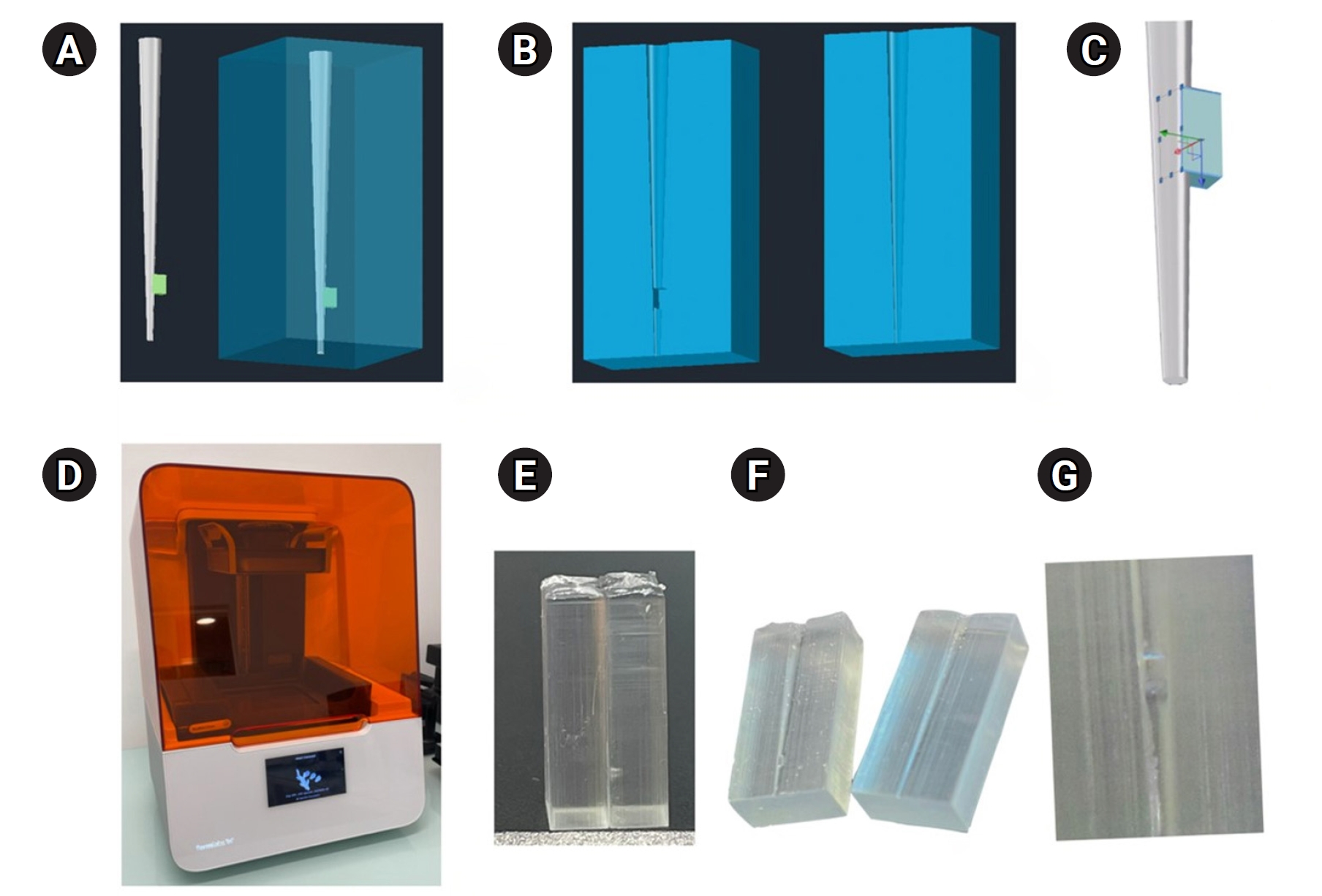
A three-dimensional printed artificial root canal with a lateral canal in the apical third was fabricated. Standardized bovine pulp tissue specimens were inserted, and three irrigation protocols were tested: group A (continuous NaOCl irrigation at 1 mL/min via syringe pump), group B (intermittent NaOCl irrigation with 0.1 mL and a 3-minute resting period), and group C (control, saline irrigation). The time for complete dissolution and the total NaOCl volume were recorded.
Results
Complete dissolution occurred in groups A and B, with significant differences in NaOCl volume and time (p < 0.05). In group A, complete dissolution was consistently observed after the 6th irrigation cycle, corresponding to a total NaOCl volume of 6.0 ± 0.66 mL per test. The average time required for complete dissolution in this group was 6 ± 0.66 minutes. In group B, complete dissolution occurred after the 4th cycle, with a total NaOCl volume of 0.4 ± 0.06 mL per test and a mean dissolution time of 12.6 ± 1.8 minutes.
Conclusions
NaOCl volume and exposure time significantly influence pulp tissue dissolution.
- 3,057 View
- 210 Download

- A new phantom to evaluate the tissue dissolution ability of endodontic irrigants and activating devices
- Kimia Khoshroo, Brinda Shah, Alexander Johnson, John Baeten, Katherine Barry, Mohammadreza Tahriri, Mohamed S. Ibrahim, Lobat Tayebi
- Restor Dent Endod 2020;45(4):e45. Published online August 24, 2020
- DOI: https://doi.org/10.5395/rde.2020.45.e45
-
Abstract
PDF
Objective The aim of this study was to introduce a gelatin/bovine serum albumin (BSA) tissue standard, which provides dissolution properties identical to those of biological tissues. Further, the study evaluated whether the utilization of endodontic activating devices led to enhanced phantom dissolution rates.
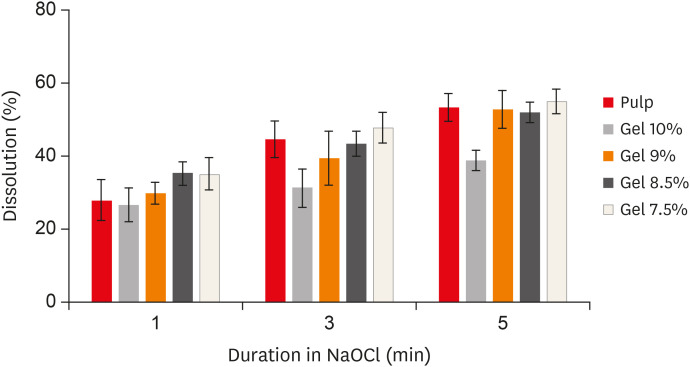
Materials and Methods Bovine pulp tissue was obtained to determine a benchmark of tissue dissolution. The surface area and mass of samples were held constant while the ratio of gelatin and BSA were varied, ranging from 7.5% to 10% gelatin and 5% BSA. Each sample was placed in an individual test tube that was filled with an appropriate sodium hypochlorite solution for 1, 3, and 5 minutes, and then removed from the solution, blotted dry, and weighed again. The remaining tissue was calculated as the percent of initial tissue to determine the tissue dissolution rate. A radiopaque agent (sodium diatrizoate) and a fluorescent dye (methylene blue) were added to the phantom to allow easy quantification of phantom dissolution in a canal block model when activated using ultrasonic (EndoUltra) or sonic (EndoActivator) energy.
Results The 9% gelatin + 5% BSA phantom showed statistically equivalent dissolution to bovine pulp tissue at all time intervals. Furthermore, the EndoUltra yielded significantly more phantom dissolution in the canal block than the EndoActivator or syringe irrigation.
Conclusions Our phantom is comparable to biological tissue in terms of tissue dissolution and could be utilized for
in vitro tests due to its injectability and detectability.-
Citations
Citations to this article as recorded by
- Evaluation of pulp tissue dissolving efficiency of sodium and calcium hypochlorite solutions activated by ultrasonics and laser: an in vitro study
Oznur Ozturk, Ozgur Genc Sen
BMC Oral Health.2024;[Epub] CrossRef
- Evaluation of pulp tissue dissolving efficiency of sodium and calcium hypochlorite solutions activated by ultrasonics and laser: an in vitro study
- 3,618 View
- 17 Download
- 1 Crossref
 First
First Prev
Prev


