
 KACD
KACD
Search
- Page Path
- HOME > Search
Research Article
- The influence of bioactive glass (BGS-7) on enamel remineralization: an in vitro study
- Chaeyoung Lee, Eunseon Jeong, Kun-Hwa Sung, Su-Jung Park, Yoorina Choi
- Restor Dent Endod 2025;50(4):e33. Published online October 15, 2025
- DOI: https://doi.org/10.5395/rde.2025.50.e33
-
 Abstract
 PDF
PDF - Objectives
The aim of this study was to compare the remineralizing capacity of bioactive glass (BGS-7, CGBIO) with other agents.
Methods
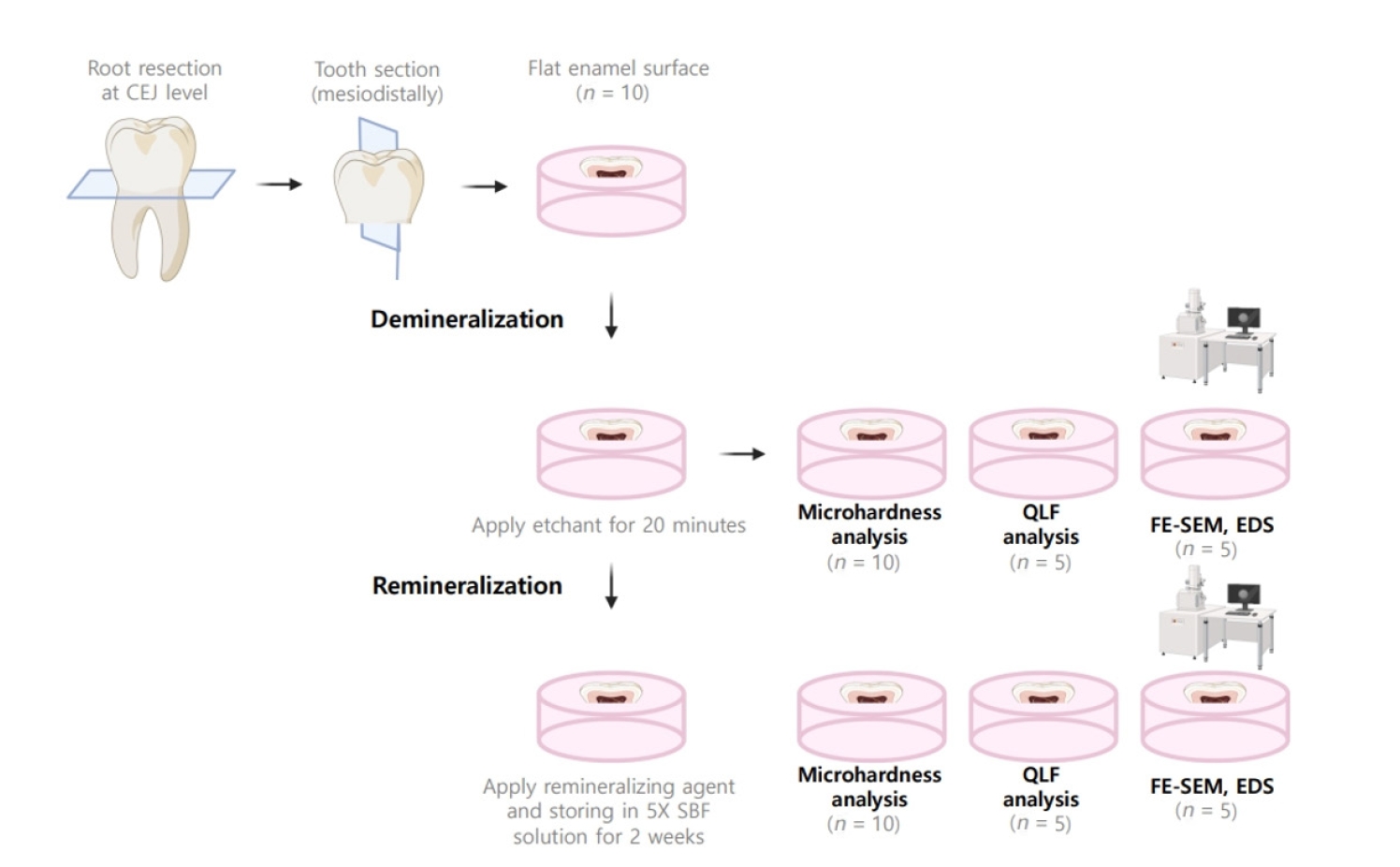
Twenty caries-free third molars were sectioned and demineralized. Specimens were divided into four groups: (1) control, (2) Clinpro XT varnish (Solventum), (3) 1.23% acidulated phosphate fluoride gel, and (4) a new type of CaO-SiO2-P2O5-B2O3 system of bioactive glass ceramics (BGS-7). Agents were applied and stored in simulated body fluid at 37℃ for 2 weeks. Microhardness was measured using the Vickers hardness testing method. Five specimens per group were analyzed using quantitative light-induced fluorescence (QLF) to assess mineral loss. Field-emission scanning electron microscopy (FE-SEM) and energy-dispersive X-ray spectroscopy (EDS) were used to examine the surface morphology and elemental composition. Data were analyzed using paired t-test and one-way analysis of variance (p < 0.05).
Results
BGS-7 showed the highest microhardness values and the greatest recovery in QLF analysis (p < 0.05). FE-SEM revealed granular precipitates on demineralized enamel in the BGS-7 group. EDS confirmed the presence of newly formed silicon and fluoride layers.
Conclusions
BGS-7 demonstrated superior remineralization capacity compared to other agents, suggesting its potential as an effective remineralizing material. -
Citations
Citations to this article as recorded by
- Bacterial ghosts (BGs): A promising approach as candidate vaccine
Helal F. Hetta, Ibraheem M. Mwafey, Noura H. Abd Ellah, Fawaz E. Alanazi, Yasmin N. Ramadan
World Journal of Microbiology and Biotechnology.2026;[Epub] CrossRef
- Bacterial ghosts (BGs): A promising approach as candidate vaccine
- 3,469 View
- 274 Download
- 1 Web of Science
- 1 Crossref

Case Report
- Application of quantitative light-induced fluorescence to determine the depth of demineralization of dental fluorosis in enamel microabrasion: a case report
- Tae-Young Park, Han-Sol Choi, Hee-Won Ku, Hyun-Su Kim, Yoo-Jin Lee, Jeong-Bum Min
- Restor Dent Endod 2016;41(3):225-230. Published online June 20, 2016
- DOI: https://doi.org/10.5395/rde.2016.41.3.225
-
Abstract
PDF
Enamel microabrasion has become accepted as a conservative, nonrestorative method of removing intrinsic and superficial dysmineralization defects from dental fluorosis, restoring esthetics with minimal loss of enamel. However, it can be difficult to determine if restoration is necessary in dental fluorosis, because the lesion depth is often not easily recognized. This case report presents a method for analysis of enamel hypoplasia that uses quantitative light-induced fluorescence (QLF) followed by a combination of enamel microabrasion with carbamide peroxide home bleaching. We describe the utility of QLF when selecting a conservative treatment plan and confirming treatment efficacy. In this case, the treatment plan was based on QLF analysis, and the selected combination treatment of microabrasion and bleaching had good results.
-
Citations
Citations to this article as recorded by- Resin Infiltration for Dental Fluorosis: A Systematic Review and Meta‐Analysis of Randomized Controlled Trials on Esthetic Masking Efficacy
Hui Han, Tian Lan, Fenglan Li, Huishan Sun
Journal of Esthetic and Restorative Dentistry.2025; 37(12): 2579. CrossRef - Management of Multifactorial Stained Enamel Defects on Anterior Dentition Using a Combination Treatment of Whitening, Microabrasion, Resin Infiltration and Resin-based Composite Restoration
A Alkhazaleh, A Tsujimoto
Operative Dentistry.2023; 48(3): 251. CrossRef - Resin Infiltration and Remineralization Interventions in Management of Moderate Dental Fluorosis
Shreepriya Singhania, B. Nandlal, Raghavendra Shanbhog, Ragavee Veeramani
Indian Journal of Dental Research.2021; 32(3): 362. CrossRef - Resolution of a fluorosis case through the association of minimally invasive techniques
Danielle Ferreira Sobral de Souza, Josué Junior Araújo Pierote, Flávio Henrique Baggio Aguiar, Luís Alexandre Maffei Sartini Paulillo, Débora Alves Nunes Leite Lima
Brazilian Journal of Oral Sciences.2019; 18: e191663. CrossRef - La micro-abrasion amélaire associée à l’éclaircissement externe: intérêt dans la prise en charge de la fluorose
Laïla Azzahim, Sanaa Chala, Faïza Abdallaoui
Pan African Medical Journal.2019;[Epub] CrossRef - Methodological considerations for designing a community water fluoridation cessation study
Sonica Singhal, Julie Farmer, Lindsay McLaren
Community Dentistry and Oral Epidemiology.2017; 45(3): 193. CrossRef - Clinical validation and assessment of a modular fluorescent imaging system and algorithm for rapid detection and quantification of dental plaque
Keith Angelino, Pratik Shah, David A. Edlund, Mrinal Mohit, Gregory Yauney
BMC Oral Health.2017;[Epub] CrossRef
- Resin Infiltration for Dental Fluorosis: A Systematic Review and Meta‐Analysis of Randomized Controlled Trials on Esthetic Masking Efficacy
- 3,076 View
- 12 Download
- 7 Crossref
 First
First Prev
Prev


