-
Influence of adjacent restorative material and distance on the accuracy of inlay cavity impressions with intraoral scanner: an in vitro study
-
So-Yeon Lee, Sung-Ae Son, Jae-Hoon Kim, Deog-Gyu Seo, Jeong-Kil Park
-
Restor Dent Endod 2026;51(1):e6. Published online January 23, 2026
-
DOI: https://doi.org/10.5395/rde.2026.51.e6
-
-
 Abstract Abstract
 PDF PDF PubReader PubReader ePub ePub
- Objectives
This study aimed to evaluate the influence of adjacent restorative material and interproximal distance on the accuracy of digital impressions of inlay cavities obtained using an intraoral scanner.
Methods
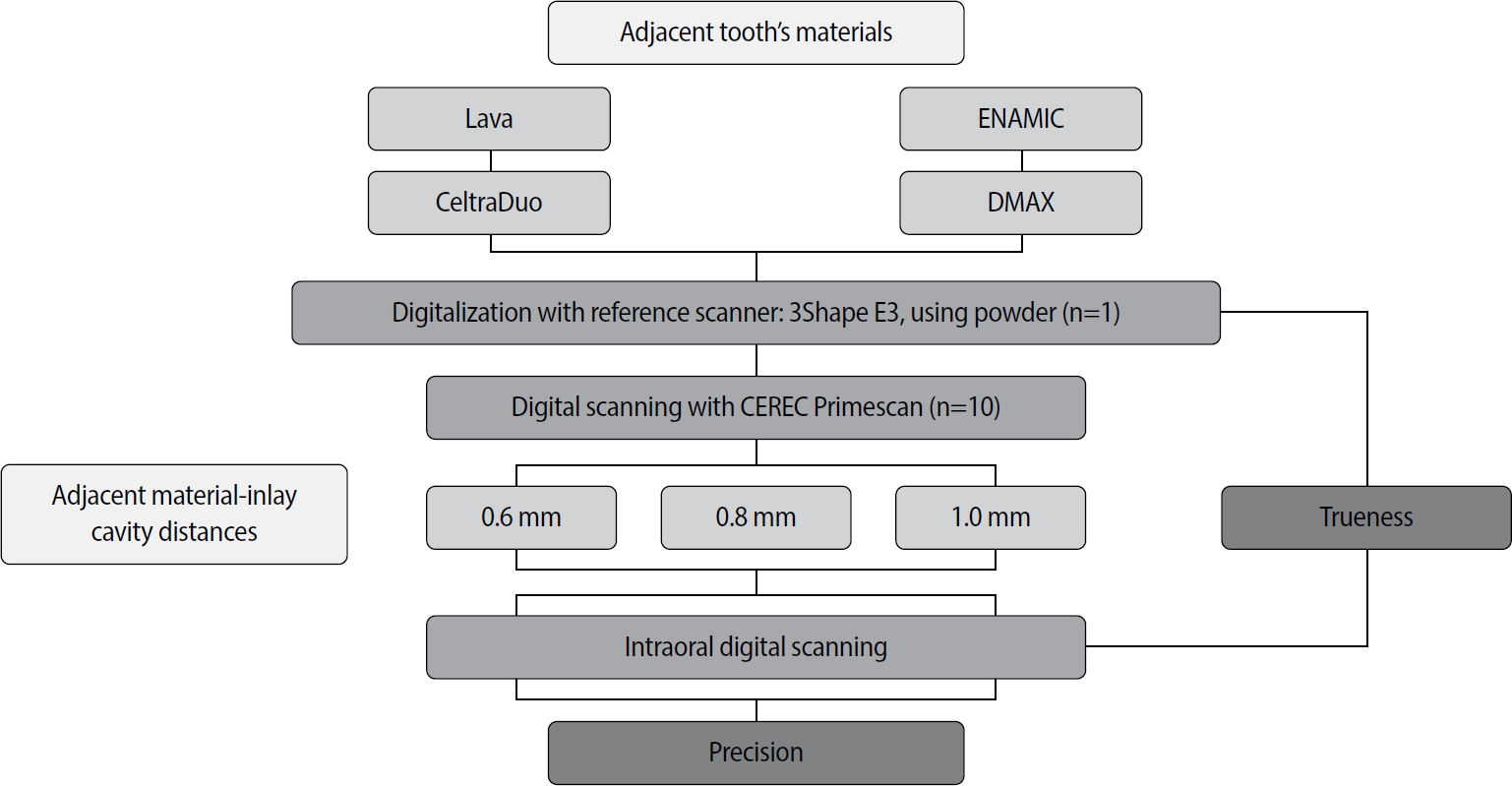
A disto-occlusal inlay cavity was prepared on a mandibular right first molar model, and digital scans were performed using a CEREC Primescan (Dentsply Sirona). The adjacent restorative materials used were Lava (3M ESPE), ENAMIC (VITA Zahnfabrik), Celtra Duo (Dentsply Sirona), and DMAX (DMAX), and the interproximal distances were set to 0.6 mm, 0.8 mm, and 1.0 mm. The obtained scan data were analyzed using GOM Inspect software (GOM GmbH).
Results
Trueness, maximum positive and negative deviations, and precision were significantly influenced by both the adjacent restorative material and the interproximal distance, while their interaction showed a significant effect only on precision. Celtra Duo demonstrated the highest trueness, with mean deviation values decreasing from 7.8 μm at a 0.6 mm interproximal distance to 7.3 μm at 1.0 mm. ENAMIC showed the best precision, presenting mean deviations of 2.6 μm at 0.6 mm, 2.9 μm at 0.8 mm, and 2.4 μm at 1.0 mm. A narrow interproximal distance of 0.6 mm resulted in lower trueness, measured at 8.3 μm, and the highest precision deviation of 3.4 μm. In contrast, an interproximal distance of 1.0 mm yielded improved scan accuracy, with increased trueness and reduced precision variation.
Conclusions
Digital impression accuracy of inlay cavities was influenced by adjacent restorative material and interproximal distance, suggesting clinical consideration is needed in CAD/CAM workflows to optimize restoration fit.
-
Citations
Citations to this article as recorded by  - 3D-SCANNING IN PROSTHETIC DENTISTRY: ADVANTAGES, DISADVANTAGES, AND DEVELOPMENT PROSPECTS
V. S. Kuz, O. I. Teslenko, H. M. Kuz, H. M. Balia, Yu. S. Lunkova, O. V. Shemetov, I. M. Martynenko
Bulletin of Problems Biology and Medicine.2026; 1(1): 98. CrossRef
-
2,206
View
-
125
Download
-
1
Crossref
-
Histological evaluation of direct pulp capping with DSP-derived synthetic peptide in beagle dog
-
Jae-Hoon Kim, Jun-Bae Hong, Bum-Soon Lim, Byeong-Hoon Cho
-
J Korean Acad Conserv Dent 2009;34(2):120-129. Published online January 14, 2009
-
DOI: https://doi.org/10.5395/JKACD.2009.34.2.120
-
-
Abstract
PDFPubReaderePub
- Abstract
The purpose of this study was to investigate the pulpal response to direct pulp capping with dentin sialo-protein (DSP) -derived synthetic peptide in teeth of dogs, and to compare its efficacy to capping substances Ca(OH)2 and white mineral trioxide aggregate (WMTA). A total of 72 teeth of 6 healthy male beagle dogs were used. The mechanically exposed pulps were capped with one of the following: (1) DSP-derived synthetic peptide (PEP group); (2) Ca(OH)2 (CH group); (3) a mixture paste of peptide and Ca(OH)2 (PEP+CH group); or (4) white MTA (WMTA group). The access cavity was restored with a reinforced glass ionomer cement. Two dogs were sacrificed at each pre-determined intervals (2 weeks, 1 month, and 3 months). After the specimens were prepared for standard histological processing, sections were stained with hematoxylin and eosin. Under a light microscope, inflammatory response and hard tissue formation were evaluated in a blind manner by 2 observers. In the PEP group, only 3 of 17 specimens showed hard tissue formation, indication that the DSP-derived synthetic peptide did not induce proper healing of the pulp. Compared with the CH group, the PEP group demonstrated an increased inflammatory response and poor hard tissue formation. The CH and WMTA groups showed similar results for direct pulp capping in mechanically exposed teeth of dogs.
-
Citations
Citations to this article as recorded by - Tubular Dentin Regeneration Using a CPNE7-Derived Functional Peptide
Yoon Lee, Yeoung-Hyun Park, Dong-Seol Lee, You-Mi Seo, Ji-Hyun Lee, Joo-Hwang Park, Han-Wool Choung, So-Hyun Park, Won Shon, Joo-Cheol Park
Materials.2020; 13(20): 4618. CrossRef - Pulp response of beagle dog to direct pulp capping materials: Histological study
Ji-Hyun Bae, Young-Gyun Kim, Pil-Young Yoon, Byeong-Hoon Cho, Yong-Hoon Choi
Journal of Korean Academy of Conservative Dentistry.2010; 35(1): 5. CrossRef
-
2,214
View
-
7
Download
-
2
Crossref
-
THE EFFECT OF PRIMING ETCHED DENTIN WITH SOLVENT ON THE MICROTENSILE BOND STRENGTH OF HYDROPHOBIC DENTIN ADHESIVE
-
Eun-Sook Park, Ji-Hyun Bae, Jong-Soon Kim, Jae-Hoon Kim, In-Bog Lee, Chang-Keun Kim, Ho-Hyun Son, Byeong-Hoon Cho
-
J Korean Acad Conserv Dent 2009;34(1):42-50. Published online January 14, 2009
-
DOI: https://doi.org/10.5395/JKACD.2009.34.1.042
-
-
Abstract
PDFPubReaderePub
- Abstract
Deterioration of long-term dentin adhesion durability is thought to occur by hydrolytic degradation within hydrophilic domains of the adhesive and hybrid layers. This study investigated the hypothesis that priming the collagen network with an organic solvent displace water without collapse and thereby obtain good bond strength with an adhesive made of hydrophobic monomers and organic solvents. Three experimental adhesives were prepared by dissolving two hydrophobic monomers, bisphenol-A-glycidylmethacrylate (Bis-GMA) and triethylenegly-col dimethacrylate (TEGDMA), into acetone, ethanol or methanol. After an etching and rinsing procedure, the adhesives were applied onto either wet dentin surfaces (wet bonding) or dentin surfaces primed with the same solvent (solvent-primed bonding). Microtensile bond strength (MTBS) was measured at 48 hrs, 1 month and after 10,000 times of thermocycles. The bonded interfaces were evaluated using a scanning electron microscope (SEM). Regardless of bonding protocols, well-developed hybrid layers were observed at the bonded interface in most specimens. The highest mean MTBS was observed in the adhesive containing ethanol at 48 hrs. With solvent-primed bonding, increased MTBS tendencies were seen with thermocycling in the adhesives containing ethanol or methanol. However, in the case of wet bonding, no increase in MTBS was observed with aging.
|

 KACD
KACD