
 KACD
KACD
Articles
- Page Path
- HOME > Restor Dent Endod > Volume 35(5); 2010 > Article
- Basic Research Effect of moisture on sealing ability of root canal filling with different types of sealer through the glucose penetration model
- Jin-Ah Jang, DDS, Hee-Lyang Kim, DDS, MS, Mi-Ja Her, DDS, MS, Kwang-Won Lee, DDS, PhD, Mi-Kyung Yu, DDS, PhD
-
2010;35(5):-343.
DOI: https://doi.org/10.5395/JKACD.2010.35.5.335
Published online: September 30, 2010
Department of Conservative Dentistry, Chonbuk National University School of Dentistry, Jeonju, Korea.
- Correspondence to Mi-Kyung Yu, DDS, PhD. Professor, Department of Conservative Dentistry, Chonbuk National University School of Dentistry, Geumam-dong, Deokjin-gu, Jeonju, Korea 561-712. Tel, +82-63-250-2045; Fax, +82-63-250-2049; mkyou102@hanmail.net
• Received: June 10, 2010 • Revised: June 26, 2010 • Accepted: July 28, 2010
Copyright © 2010 Korean Academy of Conservative Dentistry
- 5,566 Views
- 29 Download
- 5 Crossref


Abstract
-
Objectives To compared the effect of different levels of moisture of root canal on the sealing ability after filling with four different types of sealer.
-
Materials and Methods Single-rooted teeth (n = 90) instrumented to and apical size of 0.06 / 45 were randomly assigned to 12 experimental groups (n = 7 per group), positive/negative control groups (n = 3 per group). The teeth of the experimental groups (a. DRY; b. PAPER POINT DRY; c. WET) were obturated with sealer (Group 1-3: Sealapex; Group 4-6: AH plus; Group 7-9: Tubuli-seal; Group 10-12: EndoRez) and warm vertical compaction method. After 7 days in 37℃, 100% humidity, the coronal-to-apical microleakage was evaluated quantitatively using a glucose leakage model. The leaked glucose concentration was measured with spectrophotometer at 1, 3, 7, 14, 21, and 30 days. Data were recorded ad mmol/L and statistically analysed with the two-way ANOVA and Duncan test (p = 0.05).
-
Results Throughout the experimental period Tubuli-seal/WET (Group 9) showed the highest mean cumulative glucose penetration (178.75 mmol/L), whereas AH plus/DRY (Group 4) had the least (20.78 mmol/L).
-
Conclusions The results of this study demonstrated that the moisture condition of root canals at the time of obturation and the type of sealer that was used had a significant effect on leakage and sealing ability. Thus drying procedure according to sealer types is a critical step and should not be missed in endodontic treatment.
Introduction
One of the objectives of successful endodontic treatment is to prevent infection or reinfection by complete obturation of root canal system.1 However, no available material and/or technique produce a complete seal of the entire root canal system.2
Ingle et al.3 suggested up to 59% of endodontic failures are attributable to apical leakage. Failure of the apical seal allows undebrided irritants to escape from the canal into the periapcial tissue to initiate an inflammatory response.4
The most commonly used core filling material is gutta percha but these materials inherently leave discrepancies between the obturator and the canal wall and possess no natural adhesion to tooth structure.5 Therefore, root canal sealers are used with these materials to provide the required adhesion to dentin and to fill the irregularities and minor discrepancies between the core filling material and the canal walls. The sealer also acts as a lubricant during the obturation procedure. Hence, the sealing quality of a root canal filling depends on the sealing ability of the sealer.6
In some cases, the practitioner has difficulty to dry the root canal space completely before obturation which is potentially caused by poor isolation, ingress of periapical exudate or incomplete apical extension, extremely small or tortuous for using paper point. Thus, clinically these various environmental conditions of the root canal system may be related to some physical properties of sealer include setting time, solubility or water absorption, adhesion, penetration and sealing ability of a sealer.7,8
Previous endodontic textbooks recommend that the root canal space should be completely dry prior to obturation in order to increase the adhesion of sealers to the dentinal wall and the filling material.9,10 But, with recent advances in bonding system, hydrophilic methacrylate resin based sealers were introduced in dental material. The manufacturers recommended that dentinal walls are kept moist, not dehydrated to take maximum advantage of the hydrophilic properties of the sealers. Therefore, the effect of residual moisture on the apical seal should be determined.
This study compared the sealing abilities of four different types of sealer which were used in the different moisture conditions of root canal.
Materials and Methods
Ninety recently extracted single rooted human teeth were selected which have single straight root canal with fully developed apices and they are free of cracks, caries or fractures. The root was rid of attached tissues and calculus and the tooth then immersed in 0.02% sodium azide, NaN3 (DUKSAN PURE CHEMICAL CO., LTD., Ansan city, Korea) at 37℃ until use.
The coronal portion of all teeth was removed with high speed handpiece and diamond bur. (Shofu INC., Kyoto, Japan) so that each specimen was 13 mm long Straight-line entries were made and the apical patency was determined by passing a size 15 K-file. Canal working lengths were established 1.0 mm short of the apical foramina. The root canals were prepared using K3 NiTi rotary instruments (SybronEndo, Glendora, Ca, USA) at 300 rpm. All canals were enlarged with a 0.06 taper, size 45 instrument. Irrigation between each filing with 0.5 mL of 2.5% NaOCl and final flush with 3 mL of 17% EDTA (2 minute) were applied to remove smear layer.11 To remove all of the residual chemicals, final rinse with 3 mL of sterile water were applied.
All teeth were stored in distilled water of 37℃ until used. The prepared roots were randomly divided into 12 experimental groups of 7 roots, and 2 control groups of 2 roots each. Specimens were then subjected to 3 different moisture conditions.
Excess water was removed with paper points followed by dehydration with 90% ethanol and 200℃ probe of System B (Analytic Technology, Orange, CA, USA) was inserted into the root canals, twice for 5 seconds dwell time.
Blot-dried with paper point until the last one appearing dry.
Remained totally flooded with 0.05 mL distilled water.
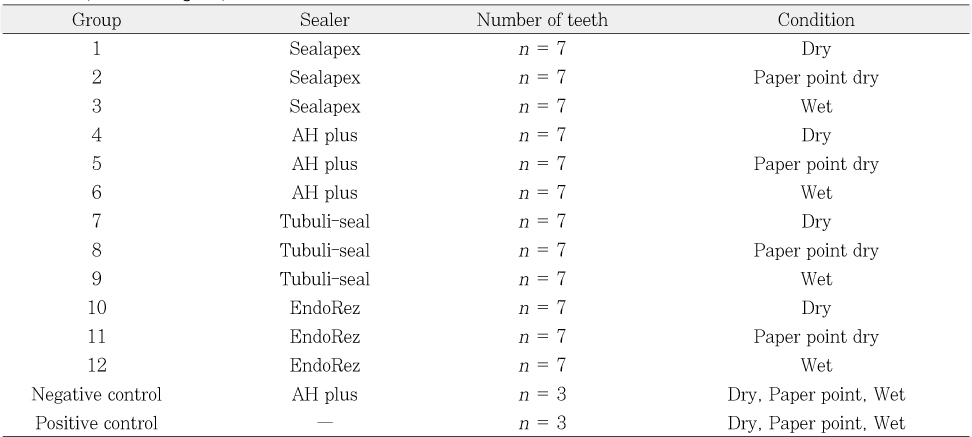
Applying the 3 moisture conditions above, the teeth were filled with the warm vertical compaction technique by using one of the 4 types of sealer. Group 1-3 were filled with a calcium hydroxide based sealer, Sealapex (Kerr, SybronEndo, Orange, CA, USA). Group 4-6 were filled with a epoxy resin based sealer, AH plus (Dentsply-Maillefer, Tulsa, OK, German). Group 7-9 were filled with a zinc oxide-eugenol-based sealer, Tubuli-seal (Kerr, SybronEndo, Orange, CA, USA). Group 7-9 were filled with a methacrylate resin-based sealer, EndoRez (Ultradent Products Inc, South Joran, UT, USA)(Table 1).
The sealers were used according to the manufacturer's recommendations.
The 3 positive control teeth were filled in a same manner but without sealer and 3 negative control teeth were filled with GP and AH Plus. The filled roots were stored in a moist gauze at 37℃ for 7 days to allow for complete setting.
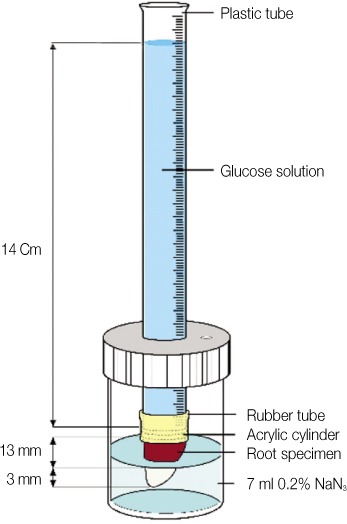
The specimens of the negative control group were completely coated with nail varnish. The specimens of the positive control and experimental groups were coated except for the area 3 mm of the apical end. The teeth were placed in a device designed to measure glucose leakage (Figure 1).12
The resin block around the coronal 4 mm of each root was inserted to a rubber tube which was itself connected to a 15 cm long plastic tube. This assembly was then placed in a 20 mL sterile glass bottle with a screw cap and sealed with Zapit cyanoacrylate (Dental Bentures of America, Inc., Corona, CA, USA). 7 mL of 0.2% NaN3 solution was inserted into the glass bottle so that the 3 mm of root apical end was immersed in the solution. NaN3 was used to inhibit the growth of microorganisms that might influence the glucose readings.12 1mol/L of glucose solution (pH 7.0) containing 0.2% NaN3 was injected into the plastic tube until the top of the solution was 14 cm higher than the top of gutta-percha in the canal which created a hydrostatic pressure of 1.5 kPa (15 cm H2O).13 This apparatus was then transferred into an incubator providing 100% humidity at 37℃. To examine the evaporation of the solution in the glass bottle, another glass bottle containing 7 ml of 0.2% NaN3, was also placed in the incubator and used to keep the volume of NaN3 solution same in the apparatus from evaporation. The weight of the supplemental solution was measured every day to figure out the amount of evaporation during test time.
A 10 µL aliquot of solution was drawn by using a micro-pipette from the glass bottle at 1, 3, 7, 14, 21, and 30 days. After drawing the sample, 10 µL of fresh 0.2 % NaN3 was added to the glass bottle reservoir to maintain a constant volume. To determine the concentration of glucose, the phenol-sulfuric acid method was used. Each 100 µL of resulted product was quantified with spectrophotometer (PowerWave; D. I. Biotech Ltd, Korea) at 490 nm wavelength. The lowest glucose level for which the current procedure is believed to be accurate is 0.75 mmol/L. The values below this were considered unreliable and recorded as o (no leakage).14
The differences between the groups were statistically analysed with the two-way ANOVA and Duncan test (version 12.0.1, SPSS, Chicago, IL, USA). The level of significance was set at α=0.05.
Results
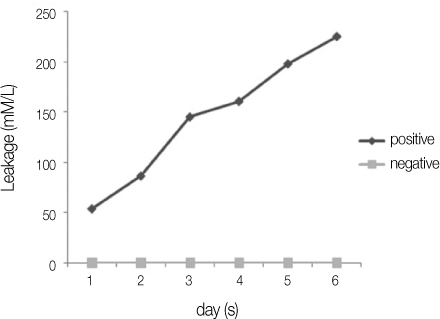
The negative control group showed no leakage of glucose. The positive control group had substantial leakage of glucose from the first day which increased rapidly over time until 30 days (Figure 2) and it showed highly significant amount of penetration compared to the experimental groups (p < 0.05).
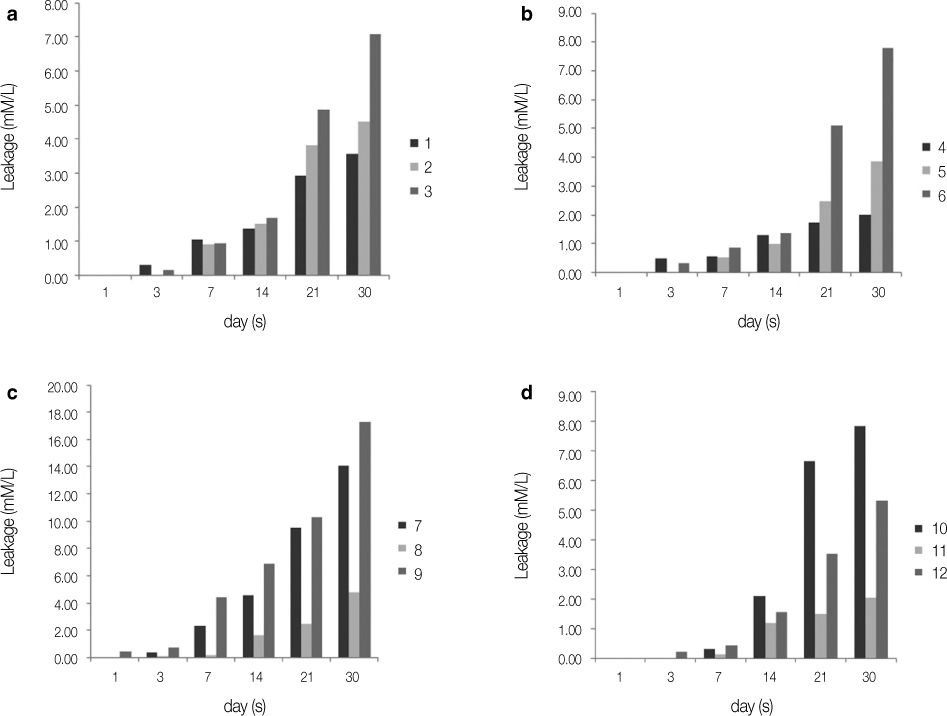
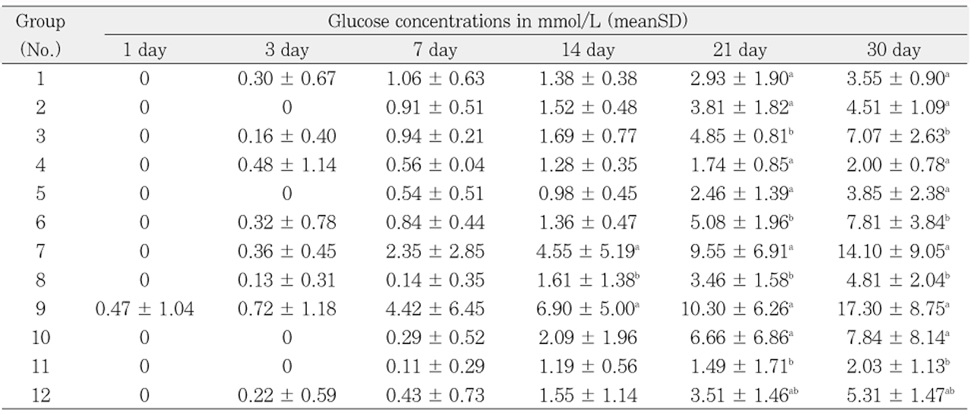
The mean glucose leakage values for each moisture condition and for each material are shown in Table 2 and Figures 3a-d.
There was a tendency of increase in leakage in all experimental groups during experimental period. There was no significant differences were found among the dry and paper point dry groups (Group 1 and Group 2 or Group 4 and Group 5), within dry and paper point dry groups (Group 1 and Group 2 or Group 4 and Group 5), within the Sealapex and AH plus groups (p > 0.05). but significantly more leakage was observed on the wet group (Group 3 and Group 6)(p < 0.05). Within the Tubli-seal groups, significantly less leakage was observed on the paper point dry group (Group 8) (p < 0.05) when compared with dry and wet groups. (Group 7, 9) Within the EndoRez groups, only significant differences were found between the dry (Group 10) and paper point dry groups (Group 11) (p < 0.05)).
Throughout the experimental period Tubuli-seal/wet (Group 9) showed the highest mean cumulative glucose penetration (17.38.75 mmol/L), whereas AH plus/dry (Group 4) had the least (2.000.78 mmol/L).
Discussion
To evaluate the sealing ability of root canal filling materials, various test methods have been applied; dye penetration, radioactive isotopes test, bacterial or bacterial metabolites leakage test, and fluid filtration. But these linear tracer penetration could not provide information that is penetrated volume of tracer and often yielded a large variation of the result.
In present study, new glucose penetration model was used. This model technique indeed, seems to have many advantages over the previous technique because of possibility of quantitative measurements, reproducibility, and sensitivity.15 Glucose is hydrophilic, has a low molecular weight (180 Da), and is an effective tracer to detect endodontic microleakage.16 Moreover, the glucose test might be more sensitive because the detected threshold measurement by eye is higher than that of the spectrophotometer. 15
In this study, phenol and sulfuric acid method, that was the easiest and most well known colorimetric assay, has been used for measurement of glucose concentration.
The fundamental principles of this assay, neutral sugars adding phenol is sulfuric acid catalyzed dehydration and condensation of the products with different developers to form characteristic chromogen.17
The results of this study demonstrated that the moisture condition of root canals at the time of obturation and the type of sealer that was used had a significant effect on microleakage.
The manufacturer of the calcium hydroxide sealer, Sealapex, states in the product insertion instructions that the canal walls must be dry before obturation.
The results of this study demonstrated that Sealapex has shown a significant more leakages when the moisture content in the canals is high. A possible reason for the results could be related to the decrease in setting time. Horning and Kessler,18 demonstrated that the setting reaction of calcium hydroxide sealers is effectively accelerated by the presence of moisture and it prevents complete wetting of the gutta-percha and the dentin of the canal walls by the sealer. This would result in poor adaptation to both surfaces as well as the formation of voids that would permit glucose penetration and leakage.
Leakage of sealer is mainly related to their solubility. Tagger et al.19 reported that Ca(OH)2 dissociated into Ca++ and OH-. The solid consequently loses content and calcium hydroxide content may dissolve leaving obturation voids. Hence this could be the cause of the poor ability of sealing.
AH plus is a epoxy resin based sealer. Some studies report the apical sealing ability of resin based sealers to be superior to that of other sealers.5,20
Under the conditions of the present study, AH plus used in dry canals showed the significantly better apical sealing ability and these data are in accordance with the results of previous reports. In the study about solubility of root-canal sealer in water and artificial saliva, AH plus presented the least leakage when compared with other sealers. This is because of its low solubility that might be related to the characteristics of its resinous matrix, which is more resistant to the solubility.21
Also AH plus showed some expansion during setting procedure, so this property compensates for the polymerization stress that are created during shrinkage.
But, in present study, significantly more leakages occur when AH plus group were used in moist and/or wet canal. Roggendorf et al.22 has described similar result. It is believed that the AH plus sealer did not adapt well to dentin walls because of the hydrophobic properties of epoxy resins.23
And a study reported that all the specimens filled with AH plus sealer leaked within 13 days. This could be because of shrinkage of this epoxy type sealer during setting.24 Thus moisture may be the relevant factor for these adverse effects.
Tubuli-seal is a ZnO-eugenol based sealer. In present study, Tubuli-seal showed the higher mean cumulative glucose penetration compared to the other groups in all moisture condition. Especially Tubuli-seal/wet (Group 9) group presented the highest leakage values and these results are in accordance with ZnO-eugenol based sealers that showed poor sealing and adhesive properties to dentin in some other investigations.25,26
In an aqueous environment, ZOE based sealers exhibited continuous solubility. This response was interpreted as water hydrolyzed the zinc-eugenolate into ZnO or Zn(OH)2 and eugenol that were detected as a slow, continuous loss of mass.27 Therefore, Tubuli-seal have shown a significant decrease in their physical properties when contaminated with moisture because of their high solubility,28 especially in the early stage of the setting reaction.29 Also as the manufacturer's instructions, the conditions of canal should be thoroughly dried prior to application because humidity will shorten the setting time of the mixed components.
But, Kuhre and Kessler,29 determined that no significant difference in the quality of the apical seal produced by zinc oxide eugenol sealer and lateral condensation of gutta percha when moisture was present in root during obturation. It is thought that this difference is due to the sealing and leakage test method.
But, for the Tubli-seal significantly less leakage was observed on the paper point dry group (Group 8). The controlled amount of moisture may work as a lubricant for these sealers that allows a better attachment to the root canal wall.22
EndoRez has been recently introduced in the market that the main component of this methacrylate based sealer is a urethane dimethacrylate (UDMA), which is an inherently hydrophobic monomer. For the purpose of making this sealer easier to insert and adapt, phosphate esters were added which render the material hydrophilic. It has been reported by the manufacturer that EndoREZ may be used on slightly moist canal because of the hydrophilicity of this sealer.
In present study, within the EndoRez groups, only the paper point dry group (Group 10) presented significantly lower leakage. So, this paper point dry condition maybe was more desirable than a totally dry or wet canal. The hydrophilicity allows penetration of resin tags and the formation of hybrid layer, resulting in micromechanical interlocking and increasing quality of sealing ability.30,31 As it is not possible to obtain completely dry surface throughout canal surface, this characteristic may be advantageous for the sealer.
But, in spite of hydrophilicity of this sealer, water can apparently not completely be displaced. Zmener et al.32 demonstrated that water permeation during the polymerization process might result in the entrapment of water droplets within the sealer dentin interface and this might result in bond disruption and further increased leakage. Wong and Spencer,33 also reported that excess water can inhibit polymerization of methacrylate based resin.
But, further long-term studies are warranted before these data can be recommended for clinical application.
Conclusions
The results of this study demonstrated that the moisture condition of root canals at the time of obturation and the type of sealer that was used had a significant effect on leakage and sealing ability. Thus drying procedure according to sealer types is a critical step and should not be missed in endodontic treatment.
The glucose model represents a useful method for performing quantitative leakage assessments.
- 1. Siqueira JF, Roças IN, Lopes HP, de Uzeda M. Coronal leakage of two root canal sealers containing calcium hydroxide after exposure to human saliva. J Endod. 1999;25: 14-16.ArticlePubMed
- 2. Glickman G, Gutmann J. Contemporary perspectives on canal obturation. Dent Clin North Am. 1992;36: 327-340.ArticlePubMed
- 3. Ingle J, Taintor J. Endodontics. 1985;3rd ed. Philadelphia: Lea & Febiger; 223-225.
- 4. Walton R, Torabinejad M. Principles and practice of endodontics. 1989;Philadelphia: WB Saunders; 421.
- 5. Limkangwalmongkol S, Burtscher P, Abbott PV, Sandler AB, Bishop BM. A comparative study of the apical leakage of four root canal sealers and laterally condensed gutta-percha. J Endod. 1991;17: 495-499.ArticlePubMed
- 6. Wu MK, De Gee AJ, Wesselink PR. Leakage of four root canal sealers at different thicknesses. Int Endod J. 1994;27: 304-308.ArticlePubMed
- 7. Himel VT, McSpadden JT, Goodis HE. In: Cohen S, Hargreaves KM, editors. Instruments, materials, and devices. Pathways of the Pulp. 2005;9th edn. St Louis, MO: Mosby Elsevier; 233-289.
- 8. Madison S, Wilcox L. An evaluation of coronal microleakage in endodontically treated teeth. Part III. In vivo study. J Endod. 1988;14: 455-458.ArticlePubMed
- 9. Cohen S, Burns R. Pathways of the pulp. 1982;5th ed. St. Louis: CV Mosby; 207.
- 10. Weine F. Endodontic therapy. 1982;3rd ed. St. Louis: CV Mosby; 341.
- 11. Lee JK, Park SH, Choi GW. Time-dependent effects of EDTA application on removal of smear layer in the root canal system. J Korean Acad Conserv Dent. 2006;31: 169-178.Article
- 12. Xu Q, Fan MW, Fan B, Cheung GS, Hu HL. A new quantitative method using glucose for analysis of endodontic leakage. Oral Surg Oral Med Oral Pathol Oral Radiol Endod. 2005;99: 107-111.ArticlePubMed
- 13. Pommel L, Camps J. Effects of pressure and measurement time on the fluid filtration method in endodontics. J Endod. 2001;27: 256-258.ArticlePubMed
- 14. Yu YS, Kim TK, Lee KW, Yu MK. Evaluation of sealing ability of root fillings without smear layer by soft chelating irrigation. J Korean Acad Conserv Dent. 2009;34: 484-485.Article
- 15. Shemesh H, Wu MK, Wesselink PR. Leakage along apical root fillings with and without smear layer using two different leakage models: a two-month longitudinal ex vivo study. Int Endod J. 2006;39: 968-976.ArticlePubMed
- 16. Wu MK, Wesselink PR. Endodontic leakage studies reconsidered. Part I. Methodology, Application and relevance. Int Endod J. 1993;26: 37-43.ArticlePubMed
- 17. Rao P, Pattabiraman TN. Reevaluation of the phenol-sulfuric acid reaction for the estimation of hexoses and pentoses. Anal Biochem. 1989;181: 18-22.ArticlePubMed
- 18. Horning TG, Kessler JR. A comparison of three different root canal sealers when used to obturate a moisture-contaminated root canal system. J Endod. 1995;21: 354-357.ArticlePubMed
- 19. Tagger M, Tagger E, Kfir A. Release of calcium and hydroxyl ions from set endodontic sealers containing calcium hydroxide. J Endod. 1988;14: 588-591.ArticlePubMed
- 20. Oguntebi BR, Shen C. Effect of different sealers on thermoplasticized gutta-percha root canal obturations. J Endod. 1992;18: 363-366.ArticlePubMed
- 21. Schäfer E, Zandbiglari T. Solubility of root-canal sealers in water and artificial saliva. Int Endod J. 2003;36: 660-669.ArticlePubMedPDF
- 22. Roggendorf MJ, Ebert J, Petschelt A, Frankenberger R. Influence of moisture on the apical seal of root canal fillings with five different types of sealer. J Endod. 2007;33: 31-33.ArticlePubMed
- 23. Zmener O, Spielberg C, Lambergghini F, Rucci M. Sealing properties of a new epoxy resin-based root-canal sealer. Int Endod J. 1997;30: 332-334.ArticlePubMed
- 24. Ørstavik D, Nordahl I, Tibballs JE. Dimensional change following setting of root canal sealer materials. Dent Mater. 2001;17: 512-519.ArticlePubMed
- 25. Barnett F, Trope M, Rooney J, Tronstak L. In vivo sealing ability of calcium hydroxide containing root canal sealers. Endod Dent Traumatol. 1989;5: 23-26.ArticlePubMed
- 26. Zidan O, El Deeb M. The use of dental bonding agent as a root canal sealer. J Endod. 1985;11: 176-178.PubMed
- 27. Markowitz K, Moynihan M, Liu M, Kim S. Biologic properties of eugenol and zinc oxide-eugenol. A clinically oriented review. Oral Surg Oral Med Oral Pathol. 1992;73: 729-737.PubMed
- 28. Peters DD. Two-year in vitro solubility evaluation of four gutta-percha sealer obturation techniques. J Endod. 1986;12: 139-145.ArticlePubMed
- 29. Kuhre A, Kessler J. Effect of moisture on the apical seal of laterally condensed gutta percha. J Endod. 1993;19: 277-280.ArticlePubMed
- 30. Tay FR, Loushine RJ, Weller RN, et al. Ultrastructural evaluation of the apical seal in roots filled with a polycaprolactone-based root canal filling material. J Endod. 2005;31: 514-519.ArticlePubMed
- 31. Tay FR, Loushine RJ, Monticelli F, et al. Effectiveness of resin-coated gutta-percha cones and a dual-cured, hydrophilic methacrylate-based sealer in obturating root canals. J Endod. 2005;31: 659-664.PubMed
- 32. Zmener O, Pameijer CH, Serrano SA, Vidueira M, Macchi RI. Significance of moist root canal dentin with the use of methacrylate-based endodontic sealers: an in vitro coronal dye leakage study. J Endod. 2008;34: 76-79.ArticlePubMed
- 33. Wang Y, Spencer P. Continuity etching of an all-in-one adhesive in wet dentin tubules. J Dent Res. 2005;84: 350-354.ArticlePubMedPDF
REFERENCES
Tables & Figures
REFERENCES
Citations
Citations to this article as recorded by 
- Effect of Root Dentin Moisture on the Apical Sealing Ability of Root Canal Sealers: In vitro Study
Zahraa Khalil Alani, Manal Hussain Abd-alla
Al-Rafidain Journal of Medical Sciences ( ISSN 2789-3219 ).2025; 8(2): 122. CrossRef - Effect of different root canal drying techniques on the push-out bond strength of ceraseal sealer – An in vitro study
R. Patil Pooja, D. N. Nirupama, Nainan Thomas Mohan, R. Vijay, Helen Thomas, P. K. Sneha
Journal of Conservative Dentistry and Endodontics.2025; 28(7): 642. CrossRef - Comparison of push‐out bond strength of endodontic sealers after root canal drying with different techniques
Ahmadreza Sarrafan, Ali Soleymani, Tasnim Bagheri Chenari, Seyedali Seyedmajidi
Clinical and Experimental Dental Research.2023; 9(2): 314. CrossRef - Quantitative microleakage analysis of root canal filling materials in single‐rooted canals
Sin‐Young Kim, Kyung‐Jae Kim, Young‐Ah Yi, Deog‐Gyu Seo
Scanning.2015; 37(4): 237. CrossRef - Evaluation of softening ability of Xylene & Endosolv-R on three different epoxy resin based sealers within 1 to 2 minutes - anin vitrostudy
Pratima Ramakrishna Shenoi, Gautam Pyarelal Badole, Rajiv Tarachand Khode
Restorative Dentistry & Endodontics.2014; 39(1): 17. CrossRef
 Cite
Cite XML Download
Effect of moisture on sealing ability of root canal filling with different types of sealer through the glucose penetration model
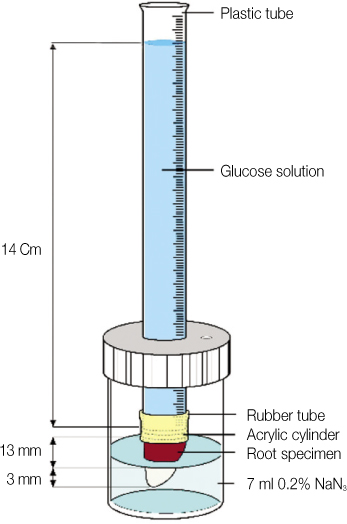
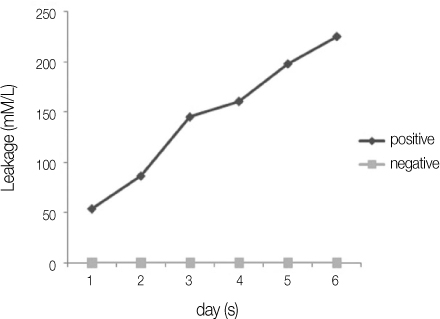
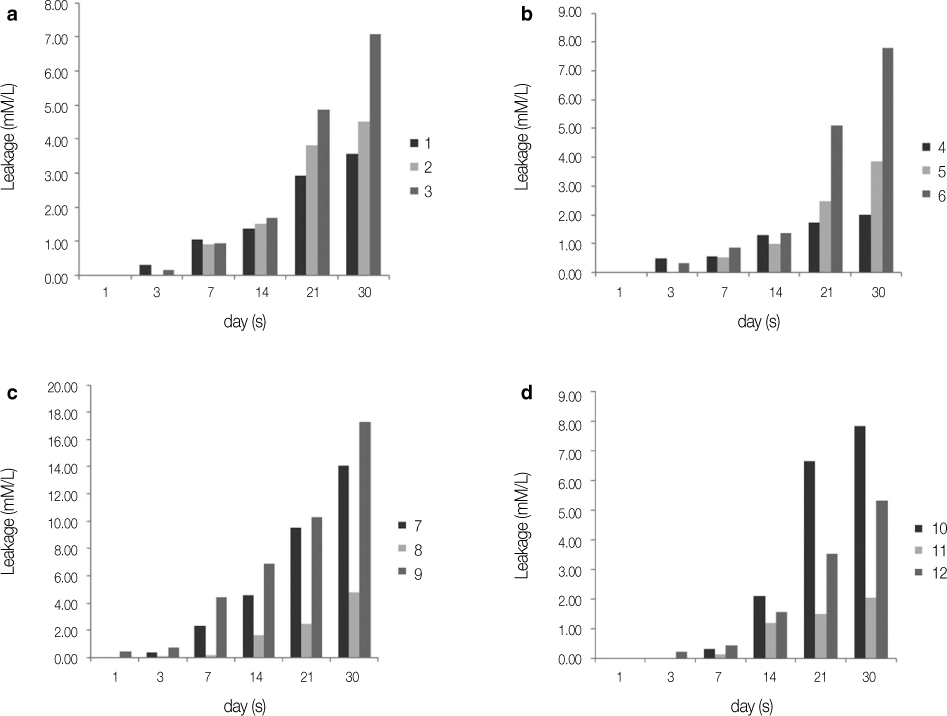
Figure 1
Glucose leakage model.
Figure 2
Leakage of positive and negative control groups.
Figure 3
Glucose microleakage of experimental groups.
a, Sealapex groups; b, AH plus groups; c, Tubuliseal groups; d, EndoRez groups.
Figure 1
Figure 2
Figure 3
Effect of moisture on sealing ability of root canal filling with different types of sealer through the glucose penetration model
Experimental groups
Microleakage of glucose in experimental groups (mM/L)
a, b: different letter indicates significant differences between groups in horizontal row (p < 0.05)
Table 1
Experimental groups
Table 2
Microleakage of glucose in experimental groups (mM/L)
a, b: different letter indicates significant differences between groups in horizontal row (


