
 KACD
KACD
Search
- Page Path
- HOME > Search
Research Article
- Concentrated growth factor scaffold-based pulpotomy of permanent molars with symptomatic irreversible pulpitis
- Arthi K. Harith, Vishnupriya Koteeswaran, Dinesh Kowsky, Natanasabapathy Velmurugan, Suresh Nandini
- Restor Dent Endod 2025;50(1):e1. Published online January 17, 2025
- DOI: https://doi.org/10.5395/rde.2025.50.e1
-
 Abstract
 PDF
PDF - Objectives
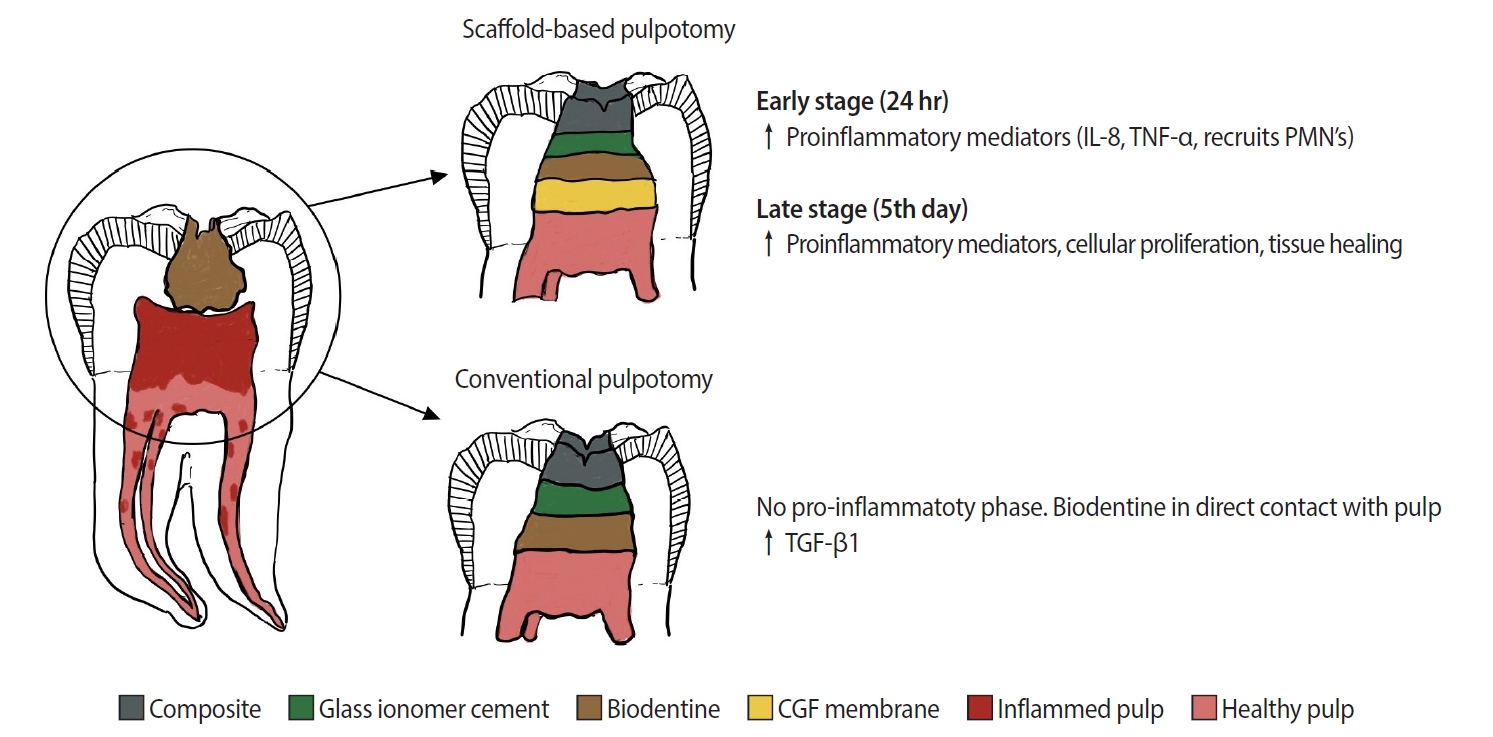
Pulpotomy is a minimally invasive procedure that aims to retain the vitality of the radicular pulp by removing the inflamed coronal pulp tissue. This case series presents the successful management of symptomatic irreversible pulpitis by pulpotomy with concentrated growth factor (CGF) scaffolds.
Methods
Six permanent mandibular molars with a diagnosis of symptomatic irreversible pulpitis were included. Under Local anesthesia and rubber dam isolation, caries were excavated using high-speed bur under coolant. Full coronal pulpotomy was done and hemostasis was achieved. CGF membrane was prepared and placed over the radicular pulp and layered with Biodentine (Septodont). Final restoration of type IX glass ionomer cement and bulk fill composite resin was placed. Patients were assessed for various clinical and radiographic parameters at intervals of 1 week and 3, 6, and 12 months. Five patients fulfilled the success criteria at the end of 1 year.
Results
Pulpotomy is considered an alternative treatment modality for root canal treatment in symptomatic irreversible pulpitis aiming at alleviating symptoms and maintaining vitality. CGF scaffold when used as a capping material acts as a reservoir for growth factors with anti-inflammatory properties and enhances healing.
Conclusions
Scaffold-based pulpotomy can be considered a biological approach to healing inflamed pulp. -
Citations
Citations to this article as recorded by
- Partial radicular versus coronal pulpotomy using chitosan and platelet-rich fibrin in vital permanent molars with irreversible pulpitis, with or without associated apical periodontitis: A randomized controlled trial
Neelam Mittal, Harakh Chand Baranwal, Deepti Singh, Chanda Dhakad, Ayushi Kejriwal, Shelly Sharma
Journal of Conservative Dentistry and Endodontics.2026; 29(8): 848. CrossRef
- Partial radicular versus coronal pulpotomy using chitosan and platelet-rich fibrin in vital permanent molars with irreversible pulpitis, with or without associated apical periodontitis: A randomized controlled trial
- 6,623 View
- 575 Download
- 1 Crossref

Basic Research
- Microbial profile of asymptomatic and symptomatic teeth with primary endodontic infections by pyrosequencing
- Sang-Min Lim, Tae-Kwon Lee, Eun-Jeong Kim, Jun-Hong Park, Yoon Lee, Kwang-Shik Bae, Kee-Yeon Kum
- J Korean Acad Conserv Dent 2011;36(6):498-505. Published online November 30, 2011
- DOI: https://doi.org/10.5395/JKACD.2011.36.6.498
-
Abstract
PDF
Objectives The purpose of this
in vivo study was to investigate the microbial diversity in symptomatic and asymptomatic canals with primary endodontic infections by using GS FLX Titanium pyrosequencing.Materials and Methods Sequencing was performed on 6 teeth (symptomatic, n = 3; asymptomatic, n = 3) with primary endodontic infections. Amplicons from hypervariable region of the small-subunit ribosomal RNA gene were generated by polymerized chain reaction (PCR), and sequenced by means of the GS FLX Titanium pyrosequencing.
Results On average, 10,639 and 45,455 16S rRNA sequences for asymptomatic and symptomatic teeth were obtained, respectively. Based on Ribosomal Database Project Classifier analysis, pyrosequencing identified the 141 bacterial genera in 13 phyla. The vast majority of sequences belonged to one of the seven phyla:
Actinobacteria ,Bacteroidetes ,Firmicutes ,Fusobacteria ,Proteobacteria ,Spirochetes , andSynergistetes . In genus level,Pyramidobacter ,Streptococcus , andLeptotrichia constituted about 50% of microbial profile in asymptomatic teeth, whereasNeisseria ,Propionibacterium , andTessaracoccus were frequently found in symptomatic teeth (69%). Grouping the sequences in operational taxonomic units (3%) yielded 450 and 1,997 species level phylotypes in asymptomatic and symptomatic teeth, respectively. The total bacteria counts were significantly higher in symptomatic teeth than that of asymptomatic teeth (p < 0.05).Conclusions GS FLX Titanium pyrosequencing could reveal a previously unidentified high bacterial diversity in primary endodontic infections.
-
Citations
Citations to this article as recorded by- Root Canal Microbiome Associated With Asymptomatic Apical Periodontitis as Determined by High-Throughput Sequencing
Rodrigo Rodrigues Amaral, Tiago Braga, José F. Siqueira, Isabela N. Rôças, Caio Tavora Coelho da Costa Rachid, Anna Gabriella Guimarães Oliveira, Maria Ilma de Souza Côrtes, Robert Mattew Love
Journal of Endodontics.2022; 48(4): 487. CrossRef - A critical analysis of research methods and experimental models to study the root canal microbiome
José F. Siqueira, Isabela N. Rôças
International Endodontic Journal.2022; 55(S1): 46. CrossRef - Oral microbiomes in children with asthma and dental caries
Sergey V. Cherkasov, Larisa Yu. Popova, Tatyana V. Vivtanenko, Rimma R. Demina, Yuri A. Khlopko, Alexander S. Balkin, Andrey O. Plotnikov
Oral Diseases.2019; 25(3): 898. CrossRef - Insights into the human oral microbiome
Digvijay Verma, Pankaj Kumar Garg, Ashok Kumar Dubey
Archives of Microbiology.2018; 200(4): 525. CrossRef - Solving the etiology of dental caries
Aurea Simón-Soro, Alex Mira
Trends in Microbiology.2015; 23(2): 76. CrossRef - Present status and future directions in endodontic microbiology
José F. Siqueira, Isabela N. Rôças
Endodontic Topics.2014; 30(1): 3. CrossRef - Application of high-throughput sequencing in understanding human oral microbiome related with health and disease
Hui Chen, Wen Jiang
Frontiers in Microbiology.2014;[Epub] CrossRef
- Root Canal Microbiome Associated With Asymptomatic Apical Periodontitis as Determined by High-Throughput Sequencing
- 2,990 View
- 10 Download
- 7 Crossref
 First
First Prev
Prev


