
 KACD
KACD
Search
- Page Path
- HOME > Search
Research Article
- Ex vivo comparative analysis of retrievability among four calcium silicate-based sealers for regaining apical patency
- Darian Shomali, Timothy Kirkpatrick, Sang Won Kwak, Hyeon-Cheol Kim, Ji Wook Jeong
- Restor Dent Endod 2026;51(1):e3. Published online January 14, 2026
- DOI: https://doi.org/10.5395/rde.2026.51.e3
-
 Abstract
 PDF
PDF - Objectives
Efficient retrievability is a key requirement for endodontic sealers. This study evaluated the retrievability of four different calcium silicate-based sealers (CSS).
Methods
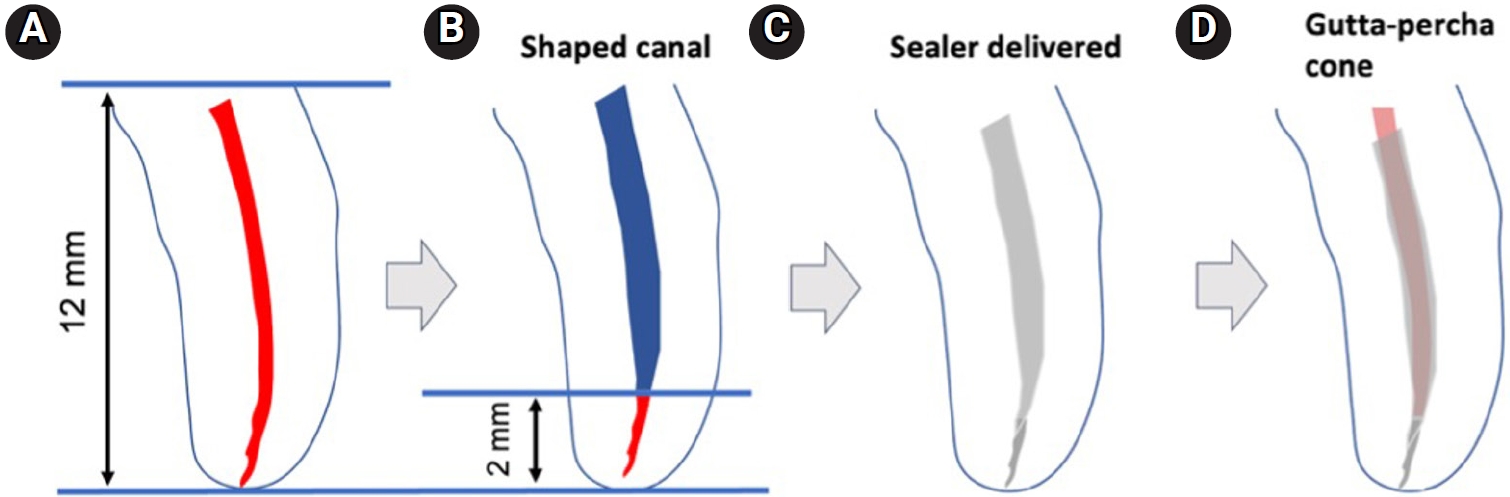
A total of 153 single-rooted human teeth with straight canals were decoronated to a standardized working length of 12 mm. The canals were negotiated to working length using K files up to size 15/.02, followed by rotary instrumentation up to 35/.04, 2 mm short of working length. The teeth were randomly assigned to five groups: NeoSEALER Flo (NEO; Avalon Biomed), Ceraseal (CS; Meta Biomed), Endosequence BC Sealer (BC; Brasseler USA), AH Plus Bioceramic Sealer (AHB; Dentsply Sirona), and a negative control group. Sealer application and obturation with a 35/.04 gutta-percha cone were performed. After incubation at 37°C in 100% humidity for 7 days, retreatment was performed until apical patency was obtained, with retrievability assessed by regaining apical patency. One-way analysis of variance and Tukey contrast test were used to determine whether there was a significant difference among the four different CSS (p < 0.05).
Results
Success rates in regaining apical patency were NEO (79.4%), CS (37.0%), BC (50.0%), and AHB (69.7%). NEO demonstrated the highest retrievability, while CS had the lowest (p < 0.01).
Conclusions
The type of CSS used has a considerable impact on retreatment difficulty. Among the tested sealers, Neo- SEALER Flo showed the highest retrievability, making it the most retrievable CSS in terms of retreatment efficacy.
- 3,040 View
- 207 Download

Original Article
- Evaluation of retrievability using a new soft resin based root canal filling material
- Su-Jung Shin, Yoon Lee, Jeong-Won Park
- J Korean Acad Conserv Dent 2006;31(4):323-329. Published online July 31, 2006
- DOI: https://doi.org/10.5395/JKACD.2006.31.4.323
-
Abstract
PDF
The aim of this study was to evaluate the retrievability of Resilon as a root canal filling material. Twenty-seven human single-rooted extracted teeth were instrumented utilizing a crown down technique with Gates-Glidden burs and ProFile system. In group1 (n = 12) canals were obturated with gutta percha and AH-26 plus sealer using a continuous wave technique and backfilled. In group 2 (n = 15) Resilon was used as a filling material. Then teeth were sealed and kept in 37℃ and 100% humidity for 7 days. For retreatment, the samples were re-accessed and filling material was removed using Gates-Glidden burs and ProFiles. Teeth were sectioned longitudinally to compare the general cleanliness and amount of debris (× 75) using SEM. Chi-square test was used (α = 0.05) to analyze the data. The total time required for removal of filling materials was expressed as mean ± SD (min) and analyzed by the Student
t -test (α = 0.05). Required time for retreatment was 3.25 ± 0.32 minutes for gutta percha/AH 26 plus sealer and 3.05 ± 0.34 minutes for Resilon. There was no statistically significant difference between the two experimental groups. There was no significant difference between the groups in the cleanliness of the root canal wall. This study showed that Resilon was effectively removed by Gates-Glidden burs and ProFiles.-
Citations
Citations to this article as recorded by
- An in vitro evaluation of effectiveness of Xylene, Thyme oil and Orange oil in dissolving three different endodontic sealers
N Aiswarya, TN Girish, KC Ponnappa
Journal of Conservative Dentistry.2023; 26(3): 305. CrossRef - A Comparative Evaluation of Two Commonly Used GP Solvents on Different Epoxy Resin-based Sealers: An In Vitro Study
Sakshi Tyagi, Ekta Choudhary, Rajat Chauhan, Ashish Choudhary
International Journal of Clinical Pediatric Dentistry.2020; 13(1): 35. CrossRef - Evaluation of softening ability of Xylene & Endosolv-R on three different epoxy resin based sealers within 1 to 2 minutes - anin vitrostudy
Pratima Ramakrishna Shenoi, Gautam Pyarelal Badole, Rajiv Tarachand Khode
Restorative Dentistry & Endodontics.2014; 39(1): 17. CrossRef - Microleakage of resilon by methacrylate-based sealer and self-adhesive resin cement
Sun-Young Ham, Jin-Woo Kim, Hye-Jin Shin, Kyung-Mo Cho, Se-Hee Park
Journal of Korean Academy of Conservative Dentistry.2008; 33(3): 204. CrossRef - Microleakage of resilon: Effects of several self-etching primer
Jong-Hyeon O, Se-Hee Park, Hye-Jin Shin, Kyung-Mo Cho, Jin-Woo Kim
Journal of Korean Academy of Conservative Dentistry.2008; 33(2): 133. CrossRef
- An in vitro evaluation of effectiveness of Xylene, Thyme oil and Orange oil in dissolving three different endodontic sealers
- 2,609 View
- 3 Download
- 5 Crossref
 First
First Prev
Prev


