
 KACD

Search
- Page Path
- HOME > Search
Research Article
- Effect of sugar and sweetener on the bleachability of coffee and tea-induced stains on composites: an in vitro experimental study
- Nilay Bayraktar, Osman Kerim Arda Karaca, Yunus Ekşılı, Mustafa Furkan Yıldırım, Osman Tolga Harorli
- Restor Dent Endod 2026;51(2):e16. Published online April 1, 2026
- DOI: https://doi.org/10.5395/rde.2026.51.e16
-
 Abstract
 PDF
- Objectives
This in vitro study evaluated the effects of various sugary and non-sugary beverages on the color change of a dental composite and the subsequent bleaching efficacy.
Methods
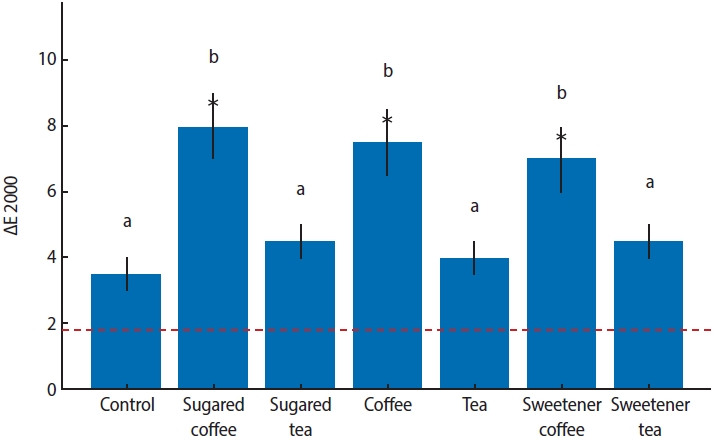
Forty-nine disc-shaped composite samples (Neo Spectra ST, Dentsply Sirona) were split into seven groups at random (n = 7). Distilled water was used to hydrate each sample for 24 hours at 37°C. After 24 hours, the first color measurements (T0) were made by using a clinical spectrophotometer (VITA Easyshade Compact; VITA Zahnfabrik). Color measurements were repeated after 7 days (T1) and 14 days (T2) of immersion in distilled water (control), tea, coffee, sugary tea, sugary coffee, tea with sweetener added, and coffee with sweetener added. After staining for 2 weeks, the specimens were bleached for 6 hours a day for a week using 16% carbamide peroxide (Opalescence Ultradent Products). Color measurements were taken again after bleaching (T3). Using CIEDE2000, color differences (ΔE) were computed. Analysis of variance (ANOVA) and repeated measures ANOVA with a Tukey post hoc test were used to evaluate the data.
Results
After 1 week, coffee-containing solutions produced significantly greater discoloration than the control (p < 0.001). By 2 weeks, tea groups exhibited similar discoloration to coffee groups (p < 0.001). The addition of sugar or sweetener had no significant effect (p > 0.05). Post-bleaching, coffee groups showed lower Whiteness Index values than the control, without statistical significance (p > 0.05).
Conclusions
Coffee and tea markedly stain resin composites, with discoloration persisting post-bleaching, while sugar or sweetener additions exert no significant effect. -
Citations
Citations to this article as recorded by
- Effects of surface treatment methods on the color stability, whiteness, and surface roughness of bleach-shade composite resins
İlayda Kutlu, Muhammet Fi̇dan
BMC Oral Health.2026;[Epub] CrossRef
- Effects of surface treatment methods on the color stability, whiteness, and surface roughness of bleach-shade composite resins
- 2,214 View
- 144 Download
- 1 Web of Science
- 1 Crossref

 First
 Prev



