
 KACD
KACD
Search
- Page Path
- HOME > Search
Research Article
- Microbial leakage and marginal adaptation of alkasite restorative material in Class II cavities: an in vitro study
- Kah Hup Chew, Norhayati Yusop, Kasmawati Mokhtar, Hafizah Ibrahim
- Restor Dent Endod 2026;51(3):e31. Published online July 28, 2026
- DOI: https://doi.org/10.5395/rde.2026.51.e31
-
 Abstract
 PDF
PDF - Objectives
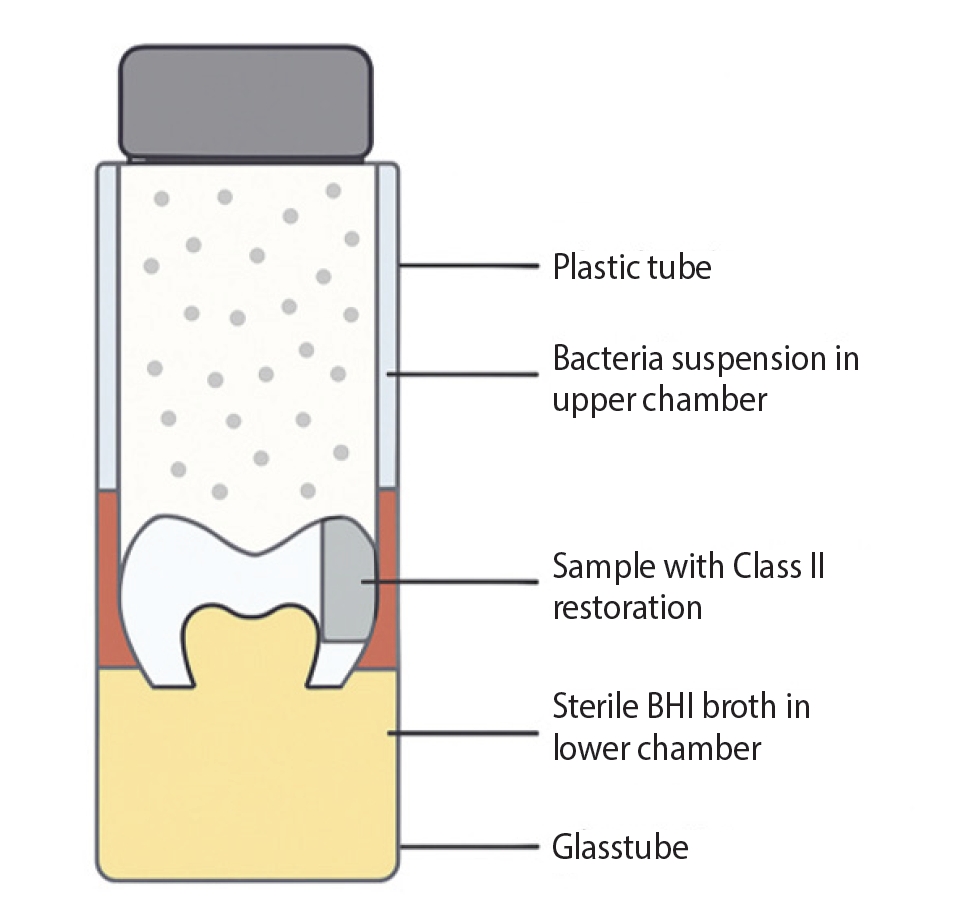
This study aimed to determine the relationship between the interfacial properties of proximal cavities (microbial leakage and marginal adaptation) and restorative materials (alkasite, resin composite, and glass hybrid). Methods: This study involved 66 human third molars that were left intact. Standardized Class II cavities were done on the mesial surface. The samples were then divided into five groups: (i) Cention N (CN, Ivoclar Vivadent), (ii) Filtek Z350XT (FZ, 3M ESPE), (iii) EQUIA Forte (GC Corporation), and (iv) two controls. For 40 days, a dual-chamber model containing Streptococcus mutans was used to study microbial leakage. Qualitative assessments of the sectioned samples were also carried out using a scanning electron microscope (SEM). Moreover, this study employed descriptive and Kaplan-Meier analyses, alongside a one-way analysis of variance for additional descriptive comparisons (p < 0.05). Results: Across different restorative materials, notable variations in microbial leakage were recorded. From the supplementary analysis between CN and FZ, a statistically significant difference was demonstrated (p = 0.037). In comparison to other restorative systems, CN also produced a prolonged mean time before microbial leakage occurred. For the interfacial properties of the restorative systems, illustrative information was offered via the SEM images. Conclusions: Regarding microbial leakage, all restorative systems presented their occurrence (despite the constraints of this study). When assessing CN and FZ restorative systems, a slower rate of microbial leakage was also concluded for CN. For the tooth-restoration interface, qualitative data were verified through SEM observations.
- 1,434 View
- 93 Download

 First
First Prev
Prev


