
 KACD
KACD
Search
- Page Path
- HOME > Search
Research Articles
- The effect of limonene extract on the adhesion of different endodontic cements to root dentin: an in vitro experimental study
- Nayara Lima Ferraz Aguiar, Eduardo José Soares, Guilherme Nilson Alves dos Santos, Anna Luísa Araújo Pimenta, Laryssa Karla Romano, Ricardo Gariba Silva, Fernanda de Carvalho Panzeri
- Restor Dent Endod 2025;50(2):e16. Published online May 12, 2025
- DOI: https://doi.org/10.5395/rde.2025.50.e16
-
 Abstract
 PDF
PDF PubReader
 ePub
ePub - Objectives
The study aimed to evaluate the effect of limonene extract (LE) on push-out bond strength (BS) to root dentin in endodontically treated teeth.
Methods
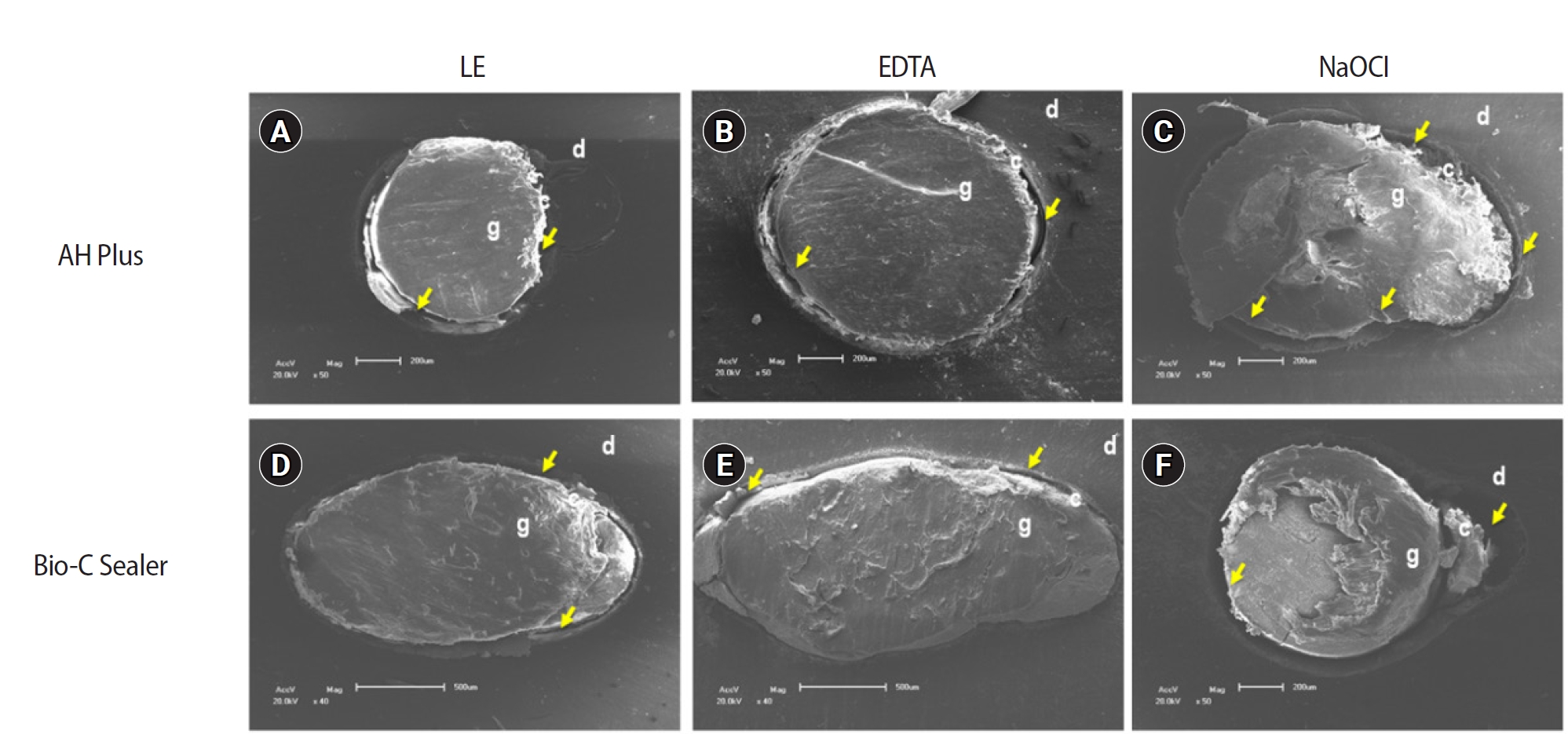
Single-rooted teeth were selected and instrumented using the reciprocating technique, then divided into three groups based on the final irrigating solution: 2.5% sodium hypochlorite (NaOCl), 17% ethylenediaminetetraacetic acid (EDTA), and 5% LE. The roots were further divided (n = 12) and obturated using the single-cone technique with epoxy resin-based (ERB) or bioceramic sealer (Bio-C). After 3 days, the roots were sectioned into 2-mm slices, obtaining two slices from each root third. Push-out BS testing was conducted at 0.5 mm/min, followed by failure pattern and adhesive interface analysis using scanning electron microscopy. Push-out BS data were analyzed by three-way analysis of variance and Tukey post-hoc test (p < 0.05).
Results
ERB showed higher BS when irrigated with EDTA (5.0 ± 2.3 MPa) compared to NaOCl (1.8 ± 1.1 MPa) (p = 0.0005), particularly in the cervical third. LE yielded intermediate values without significant differences from the other irrigants (3.5 ± 1.9 MPa) (p > 0.05). For Bio-C, the highest BS was observed in the apical third, especially with LE (9.4 ± 5.0 MPa), differing from other thirds and final irrigating solutions (p < 0.05). Mixed failure patterns were most prevalent, regardless of the irrigant solutions.
Conclusions
The combination of LE with Bio-C demonstrated superior BS in the apical third, suggesting its potential as a final irrigating solution in endodontic treatments.
- 3,384 View
- 242 Download

- Microtensile bond strength of silorane-based composite specific adhesive system using different bonding strategies
- Laura Alves Bastos, Ana Beatriz Silva Sousa, Brahim Drubi-Filho, Fernanda de Carvalho Panzeri Pires-de-Souza, Lucas da Fonseca Roberti Garcia
- Restor Dent Endod 2015;40(1):23-29. Published online August 25, 2014
- DOI: https://doi.org/10.5395/rde.2015.40.1.23
-
Abstract
PDFPubReaderePub
Objectives The aim of this study was to evaluate the effect of pre-etching on the bond strength of silorane-based composite specific adhesive system to dentin.
Materials and Methods Thirty human molars were randomly divided into 5 groups according to the different bonding strategies. For teeth restored with silorane-based composite (Filtek Silorane, 3M ESPE), the specific self-etching adhesive system (Adhesive System P90, 3M ESPE) was used with and without pre-etching (Pre-etching/Silorane and Silorane groups). Teeth restored with methacrylate based-composite (Filtek Z250, 3M ESPE) were hybridized with the two-step self-etching system (Clearfil SE Bond, Kuraray), with and without pre-etching (Pre-etching/Methacrylate and Methacrylate groups), or three-step adhesive system (Adper Scotchbond Multi-Purpose, 3M ESPE) (Three-step/Methacrylate group) (
n = 6). The restored teeth were sectioned into stick-shaped test specimens (1.0 × 1.0 mm), and coupled to a universal test machine (0.5 mm/min) to perform microtensile testing.Results Pre-etching/Methacrylate group presented the highest bond strength values, with significant difference from Silorane and Three-step/Methacrylate groups (
p < 0.05). However, it was not significantly different from Preetching/Silorane and Methacrylate groups.Conclusions Pre-etching increased bond strength of silorane-based composite specific adhesive system to dentin.
-
Citations
Citations to this article as recorded by
- Is the presence of 10-MDP associated to higher bonding performance for self-etching adhesive systems? A meta-analysis of in vitro studies
Julia Fehrenbach, Cristina Pereira Isolan, Eliseu Aldrighi Münchow
Dental Materials.2021; 37(10): 1463. CrossRef
- Is the presence of 10-MDP associated to higher bonding performance for self-etching adhesive systems? A meta-analysis of in vitro studies
- 2,147 View
- 5 Download
- 1 Crossref
 First
First Prev
Prev


