-
Effect of high irradiance and short exposure curing time on the fracture toughness of bulk-fill resin-based composite: an in vitro study
-
Beatriz Ometto Sahadi, Tainah Oliveira Rifane, Carolina Bosso André, Vitaliano Gomes Araújo-Neto, Richard Thomas Bengt Price, Marcelo Giannini
-
Restor Dent Endod 2026;51(2):e23. Published online April 20, 2026
-
DOI: https://doi.org/10.5395/rde.2026.51.e23
-
-
 Abstract Abstract
 PDF PDF PubReader PubReader ePub ePub
- Objectives
This study aimed to determine the effect of high irradiance and short exposure time on the fracture toughness of bulk-fill resin-based composites (RBCs).
Methods
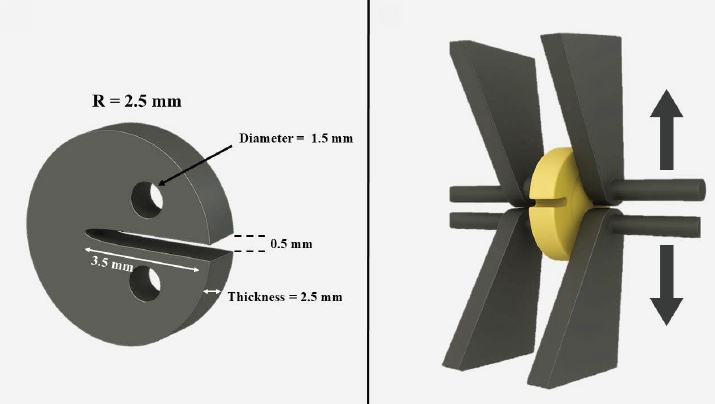
Three RBCs were tested: Tetric PowerFill (TPF; Ivoclar Vivadent), Opus Bulk Fill APS (OBF; FGM Dental Group), and Filtek One Bulk Fill (FOB; Solventum). Sixty single-edge-notched disc specimens were prepared using a fracture toughness mold. Each group consisted of 20 samples, divided into two subgroups (n = 10). The RBCs were lightcured either for 3 seconds in high-irradiance mode (‘3s cure’) or for the manufacturer-recommended times (TPF, 10 seconds; OBF, 30 seconds; FOB, 20 seconds) in ‘high power’ mode using the Bluephase PowerCure (Ivoclar Vivadent). The peak spectral wavelength was measured using a spectrophotometer. Specimens were tested on a universal testing machine, and data were analyzed by two-way analysis of variance and Bonferroni test (α = 0.05).
Results
Radiant exposure values (J/cm²) were 9.5 for the 3-second mode and 12.4, 24.8, and 37.1 for 10, 20, and 30 seconds (high power mode), respectively. FOB (4.22 and 3.79 MPa∙m0.5 for 20 and 3 seconds) had the highest mean fracture toughness, while OBF showed the lowest (2.01 and 2.10 MPa∙m0.5 for 30 and 3 seconds). TPF produced intermediate results (2.72 and 2.70 MPa∙m0.5 for 10 and 3 seconds). Exposure time did not affect TPF and OBF, while the 3-second exposure significantly reduced the fracture toughness for FOB.
Conclusions
The RBCs tested had different fracture toughness values regardless of exposure time. High irradiance and short exposure can reduce fracture toughness depending on the RBC tested.
-
Influence of inorganic composition and filler particle morphology on the mechanical properties of self-adhesive resin cements
-
Marina Rodrigues Santi, Rodrigo Barros Esteves Lins, Beatriz Ometto Sahadi, Giovanna Corrêa Denucci, Gabriela Soffner, Luís Roberto Marcondes Martins
-
Restor Dent Endod 2022;47(3):e32. Published online July 14, 2022
-
DOI: https://doi.org/10.5395/rde.2022.47.e32
-
-
Abstract
PDFPubReaderePub
- Objectives
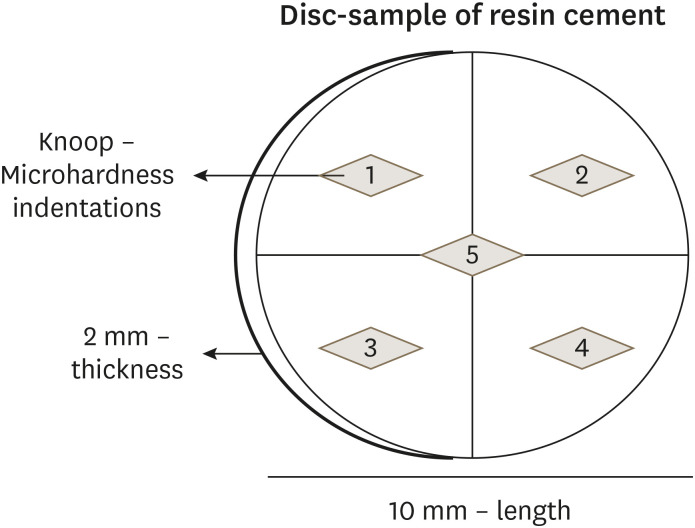
This study aimed to evaluate the influence of inorganic composition and filler particle morphology on the mechanical properties of different self-adhesive resin cements (SARCs). Materials and MethodsThree SARCs including RelyX Unicem-2 (RUN), Maxcem Elite (MAX), and Calibra Universal (CAL) were tested. Rectangular bar-shaped specimens were prepared for flexural strength (FS) and flexural modulus (FM) and determined by a 3-point bending test. The Knoop microhardness (KHN) and top/bottom microhardness ratio (%KHN) were conducted on the top and bottom faces of disc-shaped samples. Sorption (Wsp) and solubility (Wsl) were evaluated after 24 hours of water immersion. Filler morphology was analyzed by scanning electron microscopy and X-ray energy dispersive spectroscopy (EDS). FS, FM, %KHN, Wsp, Wsl, and EDS results were submitted to 1-way analysis of variance and Tukey’s post-hoc test, and KHN also to paired t-test (α = 0.05). ResultsSARC-CAL presented the highest FS value, and SARC-RUN presented the highest FM. SARC-MAX and RUN showed the lowest Wsp and Wsl values. KHN values decreased from top to bottom and the SARCs did not differ statistically. Also, all resin cements presented carbon, aluminum, and silica in their composition. SARC-MAX and RUN showed irregular and splintered particles while CAL presented small and regular size particles. ConclusionsA higher mechanical strength can be achieved by a reduced spread in grit size and the filler morphology can influence the KHN, as well as photoinitiators in the composition. Wsp and Wsl can be correlated with ions diffusion of inorganic particles.
-
Citations
Citations to this article as recorded by  - Comparative Evaluation of Color Stability in Bioactive and Conventional Resin Cements Under Thermal Stress Conditions
Alaa Turkistani, Hanin E. Yeslam
Biomimetics.2025; 10(7): 432. CrossRef - Assessment of fit accuracy and retentive strength of additively manufactured zirconia crowns luted to Ti‐base abutments with different resin cements: An in vitro study
Rafat Sasany, Sultan Merve Uçar, Burak Yilmaz
Journal of Prosthodontics.2025;[Epub] CrossRef - Bioactive Resin Cement Color Stability and Restoration Thickness as Determinants of the Final Shade in a Glass–Ceramic CAD/CAM Material
Hanin E. Yeslam, Alaa Turkistani
Journal of Functional Biomaterials.2025; 16(9): 319. CrossRef - Light transmittance through resin-matrix composite onlays adhered to resin-matrix cements or flowable composites
Rita Fidalgo-Pereira, Susana O. Catarino, Óscar Carvalho, Nélio Veiga, Orlanda Torres, Annabel Braem, Júlio C.M. Souza
Journal of the Mechanical Behavior of Biomedical Materials.2024; 151: 106353. CrossRef - Effects of a relined fiberglass post with conventional and self-adhesive resin cement
Wilton Lima dos Santos Junior, Marina Rodrigues Santi, Rodrigo Barros Esteves Lins, Luís Roberto Marcondes Martins
Restorative Dentistry & Endodontics.2024;[Epub] CrossRef - Dental Resin-Based Luting Materials—Review
Aleksandra Maletin, Milica Jeremić Knežević, Daniela Đurović Koprivica, Tanja Veljović, Tatjana Puškar, Bojana Milekić, Ivan Ristić
Polymers.2023; 15(20): 4156. CrossRef - A Scoping Review on the Polymerization of Resin-Matrix Cements Used in Restorative Dentistry
Rita Fidalgo-Pereira, Orlanda Torres, Óscar Carvalho, Filipe S. Silva, Susana O. Catarino, Mutlu Özcan, Júlio C. M. Souza
Materials.2023; 16(4): 1560. CrossRef
-
2,748
View
-
28
Download
-
7
Web of Science
-
7
Crossref
|

 KACD
KACD